Fiber Arts, Ethical AI, and Why My Assistants Can’t Knit Socks

I recently attended the Global Business Plaza and sat in on a session called Ask Peggy. As always, Peggy makes us think whether we like it or not. That conversation stayed with me and made me realize I need to be much more vocal about how I use AI and what its ethical use looks like in my world.

When I revamped Artemis North, I talked a lot about services and tech. However, I realized I left out the most important part: I don’t do this alone. As a fiber artist, I am all about the tactile. I want to feel the wool, see the way the light hits indigo, and get lost in the texture of it all. But being a late-diagnosed ADHD creative means I also have "The Boulder." You know the one. It sits on your neck, whispers that you have eighty-seven unread emails, and effectively paralyzes you until you are just staring at a wall instead of making your art.

Enter Pip, Bob, and Jim.

Pip, my alpaca mascot, is the soul of the operation. He represents the soft, creative dream. But let’s be real: Pip doesn't have thumbs, and he is terrible at spreadsheets. That is where Bob (ChatGPT) and Jim (Gemini) come in. They are my left and right hands. They are not here to replace my soul; they are here to be my dev team, my marketing department, and my "thought detanglers."

The Elephant in the Room

Someone asked me today, "Does AI write your posts?

The truth is: I love to write. I have spent a lifetime developing my "Fiberarts style" by painting pictures with words. I use AI for suggestions, to tighten my grammar, and to catch the spelling errors my racing brain misses.

But AI does not have a soul yet, and it certainly does not have a sole. I am pretty sure Jim could not knit a sock to save his life. AI does not do the dreaming. Pip handles that. Bob and Jim just help me clear the wreckage so I can finally get to the dreaming.

Sometimes, the Best "AI" is No AI at All

I will be the first to admit I get "shiny-object syndrome." Recently, I was convinced I needed a tool called Moltbot to automate my chaotic inbox. I thought I needed a complex AI solution to save me from the email boulder.

But then I sat down and looked at the tools I already had. It turned out Gmail was already powerful enough; I just had not "tuned" it yet. I did not need a bot; I needed a system.

A Mini-Alchemy Win: How to "Moltbot" Your Gmail

If you are drowning in newsletters and clutter, here is the exact move I used to clear my head:

* Spot the Noise:* In your Gmail search bar, type label:unread to see what is mocking you.

The "Waiting Room" Strategy: Click the three dots on a newsletter and select "Filter messages like these."

The Magic Sequence: Select "Skip the Inbox (Archive it)" and "Apply the label." Create a label called "Read Later."

The Result: Now, those emails go straight to their "room" instead of pinging your phone. You check them when you have the energy, not when they demand it.

Let’s Unblock the Magic Together

This is what I want to teach you. Not just "here is a cool robot," but how to look at your workflow, find the bottleneck, and shove that boulder out of the way. This works whether you use a high-tech assistant or a simple filter.

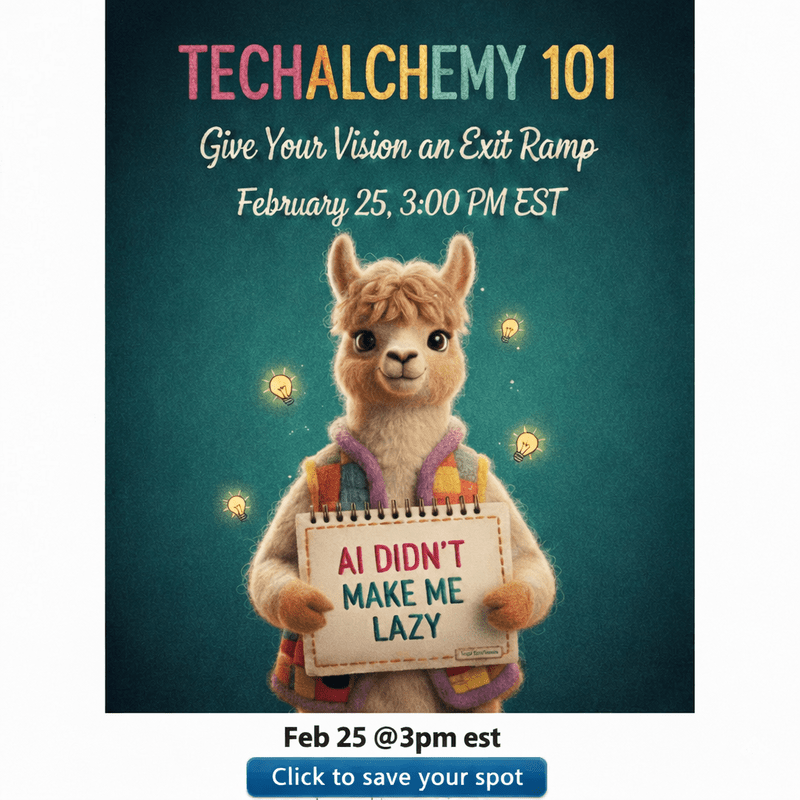
If your brain feels like a tangled skein of yarn, come join me for TechAlchemy 101. We are going to find the specific, simple tools that give you your time back. I have been there, I am still there, and I have a spare seat at the table and a very fluffy alpaca waiting for you.

Come get unblocked at TechAlchemy 101

Until next time friends...
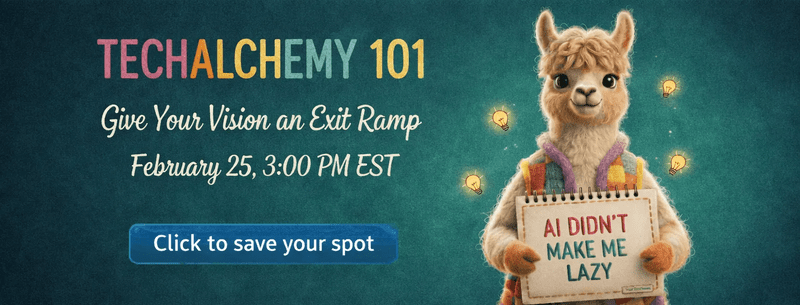
poster banner

The Laundry Room Epiphany: How a Washing Machine Taught Me to Love AI

Let’s be real for a second: if you saw me standing over a galvanized tub in the backyard, scrubbing my jeans against a metal washboard until my knuckles bled, you wouldn’t call me a “purist.” You’d call for help. You’d ask me why on earth I’m making life ten times harder than it needs to be when there is a perfectly good Maytag sitting in the laundry room.

Yet, when it comes to AI, that’s exactly where many of us are stuck. We’ve been told that using these tools is "cheating." We’ve been fed this narrative that if it isn't a struggle, it isn't "real" work.

This past Monday, I was typing up a post about exactly this. I was fired up, explaining that AI isn't some robot takeover; it’s just the modern washing machine for our mental load. Sure, you could do everything by hand-the research, the formatting, the brainstorming-but it’ll wear you out and leave you too exhausted to actually enjoy the clothes you just cleaned. Or, in our case, the art you just made.

As I hit "publish," a little lightbulb went off. I realized that just talking about the "laundry" wasn't enough. I needed to be part of the solution. I needed to show people how to actually use the machine.

The "One-Human Team" Struggle

As a Gen X creative, I grew up in the era of "figure it out yourself." But here’s the rub: mainstream companies have entire floors dedicated to what I’m trying to do at my desk. They have a design team, a dev team, a marketing team, and probably a person whose entire job is just "Strategy."

I have me. I have my computer, my art, and a very supportive husband-but none of them are going to write my curriculum or build my landing pages for me.

For years, I’d start a brilliant project and then hit "The Wall." You know the one. It’s built out of the boring-but-necessary tasks that make our neurospicy brains want to exit the building. The admin, the micro-details, the sheer volume of steps required to bring a vision to life. My brain would glitch, overwhelm would set in, and another "cool idea" would end up in the graveyard of half-finished dreams because I just couldn't focus on the "boring" parts.

Finding the Magic in the Machine

Enter my new "team": Jim (Gemini) and Bob (ChatGPT).

In the few days since that Monday epiphany, I’ve been on a total learning adventure. Instead of AI telling me what to do-which is the exact opposite of how this works-I used these tools to find my weak spots. I used them to understand how my brain actually wants to flow and to find tools that handle the bits that usually cause me to shut down.

With Jim, Bob, and my own beautiful, chaotic brain working in tandem, I’ve managed to create a hands-on, one-hour workshop from scratch. I’ve even been in the virtual trenches, altering my workshop room in The Makers' Community to make sure the space feels just right for what’s coming.

Is it 100% finished? Nope. There’s still more work to do and some digital dust to sweep up, but for the first time, I’m not sweating it. I’m confident I’ll be ready in time because I’m not scrubbing the floor with a toothbrush anymore. I have help, I have direction, and I’m actually achieving the goals I set.

Join Me in the Lab

I’m so excited to share this "TechAlchemy" with you. It isn't about becoming a tech bro or chasing "hustle culture." It’s about making the tech work for us-the makers, the fiber artists, and the thinkers who just want to get our magic out into the world without the soul-crushing overwhelm.

I’m pulling back the curtain so you can see exactly how I use these tools to bridge the gaps in my focus and keep my creative momentum alive. No shame, no "bro-marketing" pressure, and absolutely no judgment-just a warm, friendly seat at the table to see a "neurospicy" tech guide in action.

If you’re curious about how to turn your own creative "laundry list" into something manageable (and maybe even fun), I’d love to see you there.

Click here to see the details and grab your spot!

How does this feel for your "sassy but warm" vibe? If you like it, would you like me to help you draft some "behind-the-scenes" image prompts for your workshop room to use in the post?

Until next time friends...

poster

The Red Hat That Freaked Out the Nazis

Hi friends. It’s hard to know where to start lately.

I’m Canadian, and I’ve been watching my neighbours to the south go through things that are, honestly, horrifying. The kind of stuff that makes your stomach drop because you can feel how fast fear gets normalised. I can’t pretend I fully understand what it’s like to live inside that every day, but I do know this: when people’s rights and safety start getting messed with, silence helps the wrong side.

My dad was a WWII vet. He watched the early signs of what was coming, and he signed up anyway. Not because he loved war, but because he didn’t want his future kids living in a world run by cruelty, propaganda, and people addicted to power. So when I see history rhyming, I don’t want to look away.

And as a fiberartist, I keep coming back to this truth: our crafts have never been “just crafts.” They’ve always carried meaning. Sometimes comfort. Sometimes identity. Sometimes straight-up defiance.

Which brings me to one of my favourite stories of quiet resistance.

Imagine this: a knitted hat as a protest

During World War II, when Norway was occupied by Nazi Germany (starting April 1940), ordinary people needed ways to show unity without getting hauled in for it. Big gestures were dangerous. So they did what humans always do under pressure: they got smart and subtle.

In Norway, one of those subtle symbols was a red, knitted, pointed winter cap with a tassel. It’s often called a nisselue (or rød topplue).

The guardian of the farm: the Nisse

This hat wasn’t invented as a protest symbol. It was already part of Norwegian culture.

The red cap is tied to the Nisse, a gnome-like guardian figure in Norwegian folklore, connected to farms, home, and Christmas traditions. Nisser are basically always pictured in that bright red cap.

So when the occupation tried to crush Norwegian identity, the hat became more than a cute folklore thing. It became a flag you could wear on your head.

nisse

A silent, colourful rebellion

People started wearing the red nisselue as a way of saying: we’re still us.

It wasn’t loud. It wasn’t violent. But it was visible. Teens wore them in the streets. Artists put red-hatted nisser on Christmas cards alongside very Norwegian imagery and phrases like “God norsk jul” (“Good Norwegian Christmas”). Those cards were not subtle, and authorities treated them like open defiance.

There was also a broader crackdown on national symbols around that time. In late 1941, there were bans around using the Norwegian flag and its colours in ways authorities considered “demonstrations” against the occupation.

So yes. A red knitted hat could absolutely be seen as a political act.

The 1942 ban: “Stop wearing the red hats”

The red hats spread so widely that police in Trondheim basically said, “Okay, that’s enough.”

A notice dated February 23, 1942 warned that use of red toppluer had increased so much it was now considered a demonstration. The ban would apply starting Thursday, February 26, 1942. Hats could be confiscated, people could be punished, and for children under 14, the parents could be held responsible.

Let that sink in for a second.

Not a weapon. Not a poster. Not a protest march.

A red knitted hat.

That’s how fragile authoritarian control is. It panics over symbols, because symbols spread faster than orders.

And of course, the knitters pivoted

Norwegians didn’t stop resisting. They adjusted.

After the crackdown, you start seeing Christmas cards with nisser wearing hats in yellow, blue, or green instead of red, or cards that play games with the symbolism.

And alongside the hats, people used other quiet symbols too, like the paperclip worn on lapels, meaning “we are bound together.”

The pattern is always the same: when people are threatened, they find each other. When speech is controlled, they communicate sideways.

Knitting the resistance today

There’s something deeply grounding about touching this history with your own hands. Casting on stitches that someone else once knit under threat is not just “making a hat.” It’s choosing to remember. It’s choosing to pay attention.

If you want to add this to your project list, here a great Ravelry option:

Melt the ICE Hat  by YarnCultMN: a modern pattern inspired by the same red-hat symbolism, published January 2026, written for DK and worsted weight, with 200–250 yards listed.

(All proceeds from the sale of this pattern go to the immigrant aid agencies who will distribute the funds to those impacted by the actions of ICE)

Closing: what do we do with any of this?

I don’t have a neat little bow to tie on this, because real life isn’t neat.

But I do believe this: as citizens of the world, we don’t get to outsource our morals. The best we can do is stay awake, stay curious, stay connected, and use whatever we have to push back against dehumanization, everywhere. Sometimes that looks like donating, calling reps, showing up for a neighbour, supporting journalists, or protecting someone who’s being targeted. Sometimes it looks like building community so people aren’t isolated. And sometimes, yes, it looks like making something with your hands that says: you are not alone.

Because history doesn’t just remember the loud heroes. It remembers the millions of ordinary people who refused to let fear become normal.

Until next time friends...