
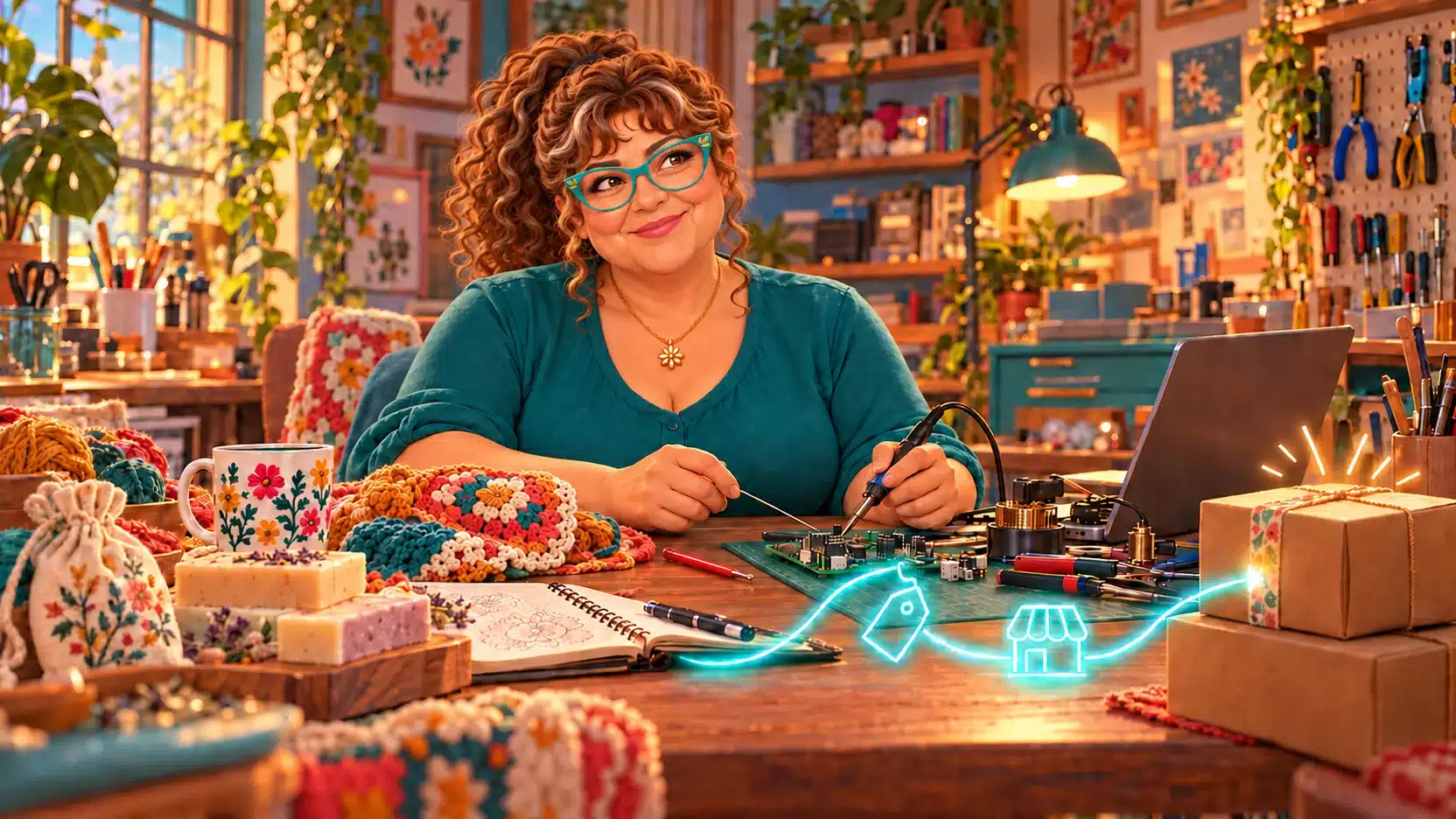
I'm looking for five creative, neurodivergent people to beta test Carry On, Creative, the app I built to help turn a handmade, artistic or digital idea into a clear path toward a first sale.
Testing is free during the beta. We'll meet weekly in the TechAlchemy Village to answer questions, work through whatever gets in the way and gather the kind of honest feedback that says, “This made no bloody sense,” when that is the useful truth. Cameras and microphones are optional, and you don't need a formal diagnosis or technical expertise.
Learn about the free beta circle and apply
If that sounds like you, there's the important bit. The rest is how I ended up building the thing in the first place.
For years, I had ideas for businesses I could start.
I could sell my handmade goods. Fibre arts. Soap. Patterns. Classes. I knew how to make things, and I could see how those things might become a business.
Then I would run into the business tools.
They were all going to make everything easier, naturally. All I had to do was choose the right platform, understand the jargon, compare seventeen options, create several accounts, work out what connected to what and remember which free trial was about to charge my credit card.
Easy.
I wanted to sell soap. I didn't want a second, unpaid career arguing with software.
The irritating part was that technology itself wasn't the problem. I'm a total geek. I build websites, solder things and play with the cool toys to find out what they can do. I like technology.
I don't like tools that promise to simplify one job and quietly add three more.
Still, I did what I usually do. I read. I researched. I tried things. I went down rabbit holes, found adjoining rabbit holes and occasionally forgot which original rabbit hole had brought me there.
I'm an introvert and an overthinker. Neither of those things is especially helpful when a business requires you to make a hundred decisions and then announce your existence to other humans.
Eventually, I'd get so frustrated that I'd walk away.
There was no dramatic table-flipping exit. I'd simply stop mentioning the idea and move on, while privately adding it to the growing pile of things I apparently couldn't follow through on.
What exactly was my defect?
That was the part I couldn't understand.
I could learn complicated creative skills. I could solve problems. I could work hard. Why could I want something so much, put that much effort into it and still fail to get it off the ground?
What was wrong with me?
Was I lazy? Undisciplined? Not as capable as I thought I was? Other people seemed to manage this stuff. Admittedly, some of them were loud enough to convince the entire internet they had personally invented commerce, but they were still getting their work out there.
I wasn't.
It's only been three or four years since I found out I have ADHD.
That explained a few things. Quite a few things, actually.
It didn't finish my abandoned projects or lead me gently out of every rabbit hole. It did explain why tools that expected me to hold the entire business in my head, prioritize twenty competing decisions and keep going through the boring bits were such a spectacularly bad fit.
I hadn't been failing a basic character test. I had been trying to work without an accurate manual for my own brain.
Useful information. It would've been even more useful several decades earlier, but apparently we enjoy a late plot twist.
I figured out what worked
I started paying attention to what actually helped me make progress.
I found ways to get information out of my head, make the next step visible and reduce the number of decisions fighting for attention. I tried tools, kept what helped and got rid of what created more work than it removed.
There was a fair amount of fucking around and finding out.
Some attempts worked. Some failed. Some sent me on scenic detours I did not need but can now describe in tedious detail. I learned, redirected and tried again.
That's how I've managed to achieve goals I couldn't reach before. It is also one of the main reasons I started TechAlchemy. I know what it's like to be perfectly capable of doing the work and still get stopped by the machinery wrapped around it.
I also know that once I've finally figured something out, my next thought is usually, “Well, somebody else shouldn't have to go through all that nonsense.”
Eventually, I built the tool I kept looking for.
From “I can make this” to “someone can buy this”
The app guides people with ADHD through the journey from pricing what they want to sell to making their first sale.
My own experience comes from handmade, artistic and creative work, so that is where my heart naturally went while I was building it. Creative people can do astonishing things with fibre, clay, paint, ingredients, words or whatever else we've dragged home because it looked interesting.
Turning the thing into a business is a different job.
You need to decide what you're selling. You need to price it. You need somewhere for people to buy it and some way to let them know it exists. Eventually, somebody says yes, which is excellent and also creates an entirely new collection of things that need to happen.
The same foundations apply to digital dreams. A pattern, an online class, a download, a digital product or another online offer still has to travel from idea to something a real person can buy.
Building the app gave both sides of my brain something useful to do. The maker understands how much the idea matters. The geek wants the structure, logic and tools to behave properly. They don't always share a filing system, but they worked well together here.
That is what the app is built to help with: the business underneath the creative idea, laid out clearly enough that you can work through it without having to reconstruct the entire plan every time you come back.
I think it does that rather well.
There. Nobody needs to arrange a parade.
Now I need other brains
Having ADHD means I understand my experience of ADHD. It did not come with authority over everybody else's brain, which is probably for the best.
I'm looking for neurodivergent people who would like to beta test the app with a business idea of their own.
You might want to sell something handmade, offer a class, publish a pattern, create a digital product or finally do something with the online business idea you've been researching since approximately the invention of Wi-Fi.
I'd like you to use the app and tell me what happens.
Where does it help? Where do you get lost? What needs more explanation? Which part makes you wonder what the hell I was thinking?
You may say, “This makes no sense.” I will not require the feedback sandwich. We are adults, and nobody has time to hide the useful bit between two slices of compliments.
My plan is to hold weekly gatherings in the Village, our online gathering space. We can answer questions, work through whatever is getting in the way and talk about what would make the app more useful.
No grand mastermind energy. Bring the idea, the question or the bit that has you muttering at your computer. We'll start there.
If you don't know how to explain where you're stuck, use this:
I'd like to sell ______, and the bit I keep getting stuck on is ______.
“I don't know what the next step is” is a perfectly good answer.
Apply for one of the five free beta spots
I spent years figuring out pieces of this the hard way. If what I've built can shorten that road for somebody else, good. That's the point.
Bring the mess. We'll figure out the next bit.
Until next time Friends...