The Laundry Room Epiphany: How a Washing Machine Taught Me to Love AI

Let’s be real for a second: if you saw me standing over a galvanized tub in the backyard, scrubbing my jeans against a metal washboard until my knuckles bled, you wouldn’t call me a “purist.” You’d call for help. You’d ask me why on earth I’m making life ten times harder than it needs to be when there is a perfectly good Maytag sitting in the laundry room.

Yet, when it comes to AI, that’s exactly where many of us are stuck. We’ve been told that using these tools is "cheating." We’ve been fed this narrative that if it isn't a struggle, it isn't "real" work.

This past Monday, I was typing up a post about exactly this. I was fired up, explaining that AI isn't some robot takeover; it’s just the modern washing machine for our mental load. Sure, you could do everything by hand-the research, the formatting, the brainstorming-but it’ll wear you out and leave you too exhausted to actually enjoy the clothes you just cleaned. Or, in our case, the art you just made.

As I hit "publish," a little lightbulb went off. I realized that just talking about the "laundry" wasn't enough. I needed to be part of the solution. I needed to show people how to actually use the machine.

The "One-Human Team" Struggle

As a Gen X creative, I grew up in the era of "figure it out yourself." But here’s the rub: mainstream companies have entire floors dedicated to what I’m trying to do at my desk. They have a design team, a dev team, a marketing team, and probably a person whose entire job is just "Strategy."

I have me. I have my computer, my art, and a very supportive husband-but none of them are going to write my curriculum or build my landing pages for me.

For years, I’d start a brilliant project and then hit "The Wall." You know the one. It’s built out of the boring-but-necessary tasks that make our neurospicy brains want to exit the building. The admin, the micro-details, the sheer volume of steps required to bring a vision to life. My brain would glitch, overwhelm would set in, and another "cool idea" would end up in the graveyard of half-finished dreams because I just couldn't focus on the "boring" parts.

Finding the Magic in the Machine

Enter my new "team": Jim (Gemini) and Bob (ChatGPT).

In the few days since that Monday epiphany, I’ve been on a total learning adventure. Instead of AI telling me what to do-which is the exact opposite of how this works-I used these tools to find my weak spots. I used them to understand how my brain actually wants to flow and to find tools that handle the bits that usually cause me to shut down.

With Jim, Bob, and my own beautiful, chaotic brain working in tandem, I’ve managed to create a hands-on, one-hour workshop from scratch. I’ve even been in the virtual trenches, altering my workshop room in The Makers' Community to make sure the space feels just right for what’s coming.

Is it 100% finished? Nope. There’s still more work to do and some digital dust to sweep up, but for the first time, I’m not sweating it. I’m confident I’ll be ready in time because I’m not scrubbing the floor with a toothbrush anymore. I have help, I have direction, and I’m actually achieving the goals I set.

Join Me in the Lab

I’m so excited to share this "TechAlchemy" with you. It isn't about becoming a tech bro or chasing "hustle culture." It’s about making the tech work for us-the makers, the fiber artists, and the thinkers who just want to get our magic out into the world without the soul-crushing overwhelm.

I’m pulling back the curtain so you can see exactly how I use these tools to bridge the gaps in my focus and keep my creative momentum alive. No shame, no "bro-marketing" pressure, and absolutely no judgment-just a warm, friendly seat at the table to see a "neurospicy" tech guide in action.

If you’re curious about how to turn your own creative "laundry list" into something manageable (and maybe even fun), I’d love to see you there.

Click here to see the details and grab your spot!

How does this feel for your "sassy but warm" vibe? If you like it, would you like me to help you draft some "behind-the-scenes" image prompts for your workshop room to use in the post?

Until next time friends...

poster

AI Didn’t Make Me Lazy. It Made My Vision Possible.

There’s a "spicy" little myth floating around that using AI is "cheating". The narrative suggests you’ve simply outsourced your soul, kicked your feet up, and are lounging in a silk robe while a robot does the heavy lifting.

First of all: hilarious. Second: if you saw the sheer volume of my "neurospicy" to-do list, you’d know AI didn’t make me lazy. It made me able to finish things.

The Executive Function Tax

As a creative with a loud imagination, ideas have never been my problem. I can see the "brain-movie" of a finished project-the vibe of a space, the structure of a workshop, the flow of a landing page-long before it exists

My struggle is the bottleneck. It’s the 18-step obstacle course between "in my head" and "in the real world". It’s the tabs, the half-drafts, and the "I’ll come back to this later" pile that inevitably turns into a digital junk drawer with legs.

For me, AI isn’t the creator. I am the creator. AI is the translator-the assistant that helps me get the vision out of my brain before it evaporates.

From Brain-Movie to Concrete Reality

When people say AI makes things "too easy," I have to ask: Easy for whom?. The hard part isn't typing; it’s pulling the right words out of the fog while juggling ten jobs and an ADHD brain that’s playing the "where did I put that important thing" game on hard mode.

AI helps me do the part that drains me so I can do the part that lights me up.

  • It reduces friction: Taking a chaotic brain dump and turning it into a structured plan, a script, or a checklist.
  • It provides accessibility: Using a tool to lower the "starting cost" of a task isn't a moral failure-it's building a digital wheelchair ramp for your mind.
  • It prevents burnout: Efficiency is what keeps you from rage-quitting your own dreams.

Taste is the Anchor

AI can generate a lot of content, but most of it is "beige"-like unseasoned chicken. It lacks your lived experience, your humor, and your "nope, that’s not it" radar.

I still steer the ship. I decide what is aligned and what is "corporate nonsense". If anything, AI has made my voice clearer because it forces me to articulate exactly what I mean. I’m constantly refining, defining, and putting my personality in on purpose.

Building a Team (Without the Payroll)

The biggest shift has been treating AI like a diverse department rather than a single tool. Running a creative business means you're wearing fifteen hats at once:

  • **The Copywriter**: Tightening captions and brainstorming hooks.
    
  • **The Dev Assistant**: Troubleshooting tech without spiraling into ten open browser tabs.
    
  • **The Brand Strategist**: Refining messaging to ensure it makes sense to people who don't live inside my head.
    

I am still the Director. AI isn't running my business; it’s helping me run it so I can actually remember to do things like "drink water".

Systems Beat Willpower

Working with AI is a learned skill, not magic. It’s about iteration-learning how to give better direction, provide context, and shape the output until it clicks.

My visions were never the problem. The bottleneck was. I’m not using AI because I don’t want to do the work; I’m using it because I want the ideas in my head to become real tools people can use and art they can connect with.

AI didn't make me lazy. It gave my vision a way out.

Until next time, friends...

“You Believe the Wrong News”: The Psychology Behind the Shutdown

Yesterday on Hive, I got one of those comments that’s half static, half attitude. The message itself was so garbled I couldn’t even tell what point she was trying to make. Then came the follow-up: I “believe the wrong news outlets.”

Ah yes. The classic. Insult first, then pretend you’re the reasonable one while you imply the other person is brainwashed. It’s a move, and it’s everywhere right now.

I didn’t clap back. I just wished her a nice day and kept it moving. But it stuck in my brain, because it made me wonder: how do people get to a place where they can dismiss credible reporting, video, and eyewitness accounts as “propaganda”… and feel righteous about it?

A recent example is the public outcry around two fatal encounters in Minneapolis involving federal immigration agents, including the deaths of U.S. citizens Renée Nicole Good and Alex Pretti. Major outlets have reported on the cases, and lawmakers have been seeking records and answers, which tells you this isn’t just “internet drama.”

So what’s actually happening in the human brain when someone’s default response is, “Fake news”?

When politics becomes identity, facts feel like an attack

At first, politics is preferences: taxes, healthcare, immigration, whatever. For some people it shifts into identity: This is my team. These are my people. This is who I am.

Once that happens, criticism of the leader or movement doesn’t land as information. It lands as a threat.

Not “Maybe I should reconsider this.” More like:

  • “You’re calling me stupid.”

  • “You’re calling my people evil.”

  • “You’re trying to take away my place in the world.”

If you’ve ever watched someone defend a messy relationship way past the point of reason, you already understand the vibe. It’s not about logic. It’s about protecting the self.

Motivated reasoning: your brain turns into a defense lawyer

Motivated reasoning is basically when the brain stops being a judge and becomes a lawyer hired by your feelings.

Same person, same IQ, same ability to analyze… but the standards change depending on whether the information helps or hurts “their side.”

  • If a story makes their team look good, it’s “obvious” and “common sense.”

  • If a story makes their team look bad, suddenly it’s “biased,” “out of context,” “doctored,” “the media always lies.”

So when someone says “you believe the wrong outlets,” sometimes it’s not a real critique. It’s a reflex that lets them avoid grappling with anything uncomfortable.

Cognitive dissonance: the brain hates the sentence “I might be wrong”

Cognitive dissonance is the mental itch you get when two beliefs can’t comfortably coexist, like:

  • “My side is the good guys.”

  • “My side is connected to something horrifying.”

That clash hurts. So the mind reaches for the quickest painkiller, not the most accurate conclusion.

That’s how people end up with lines like:

  • “That didn’t happen.”

  • “It happened, but it’s exaggerated.”

  • “It happened, but they deserved it.”

  • “It happened, but it was staged.”

“Propaganda” is the ultimate shortcut because it turns a complicated reality into a simple dismissal. One word, no discomfort.

Group belonging is stronger than “being right”

Here’s the part people underestimate: humans are wired for belonging. And belonging is not a cute personality trait. It’s survival software.

If someone’s social world is tied to a political identity, changing their mind can mean real consequences: conflict, shame, isolation, losing their online tribe, losing their offline peace.

So even if doubt flickers privately, it gets crushed publicly. Doubling down becomes the safer option.

This is why the “wrong news” accusation is so popular. It’s not just an argument. It’s a loyalty signal. A little flag they wave to show they’re still part of the group.

“The media lies” becomes a filter, not a thought

Healthy skepticism says: “Let’s verify this.”

But there’s another mode where “mainstream sources are lying” becomes the default setting. Once that filter is installed, any negative information about the leader is automatically tagged as hostile content.

At that point, evidence is not evaluated. It’s rejected.

And the person rejecting it can genuinely feel like they’re being smart and protected. That’s the twist. The rejection itself feels like wisdom.

Conspiracy thinking can feel comforting

A messy world is hard to tolerate. Randomness is scary. Injustice is scary. The idea that powerful systems can hurt people and there’s no clean explanation is… a lot.

Conspiracy stories offer emotional relief:

  • Someone is in control.

  • Nothing is random.

  • You are one of the few who “sees the truth.”

That last one is addictive. Confusion turns into superiority, and suddenly doubt feels like weakness.

The goal isn’t to “win,” it’s to stay human

I’m not writing this to start a war, and I’m not interested in dunking on strangers for sport. I’m writing it because I want people to understand what they’re up against when a conversation collapses into “wrong outlets” and “propaganda.”

Because here’s the truth: you can’t fact-check someone out of a position they’re using to protect their identity and social safety.

You can sometimes lower the temperature by shifting the conversation from teams to values:

  • “Do you believe citizens should be safe from excessive force and have accountability when things go wrong?”

  • “What evidence would you consider trustworthy, and why?”

  • “Can we talk without insults, or are we done here?”

That last one matters. Boundaries are not mean. They’re adult.

Wrap-up: Carney, Havel, and the little sign in the window

This is why Prime Minister Mark Carney’s Davos speech hit me so hard. In his address at the World Economic Forum on January 20, 2026, he referenced Václav Havel’s essay The Power of the Powerless and the “greengrocer” story: a shopkeeper displays a political slogan he doesn’t believe because it’s safer to comply than to stand out. Havel’s point was that systems survive when ordinary people keep performing the lie. (You can read the full speech here.)

That’s what a lot of “you believe the wrong news” comments are, if we’re being honest. It’s a sign in the window. It’s a performance of belonging.

And if we want a better world, we need more people willing to take the sign down, ask hard questions, and “live in truth,” even when it’s uncomfortable.

Not perfectly. Just honestly.

Until next time friends...

When Life Hands You Lemons, Make Green Tea Lemonade With Mint.

Warning: Heavy Sarcasm Ahead (Especially at Microsoft’s Expense)
If you’re a hardcore Windows fan-girl, grab a helmet.

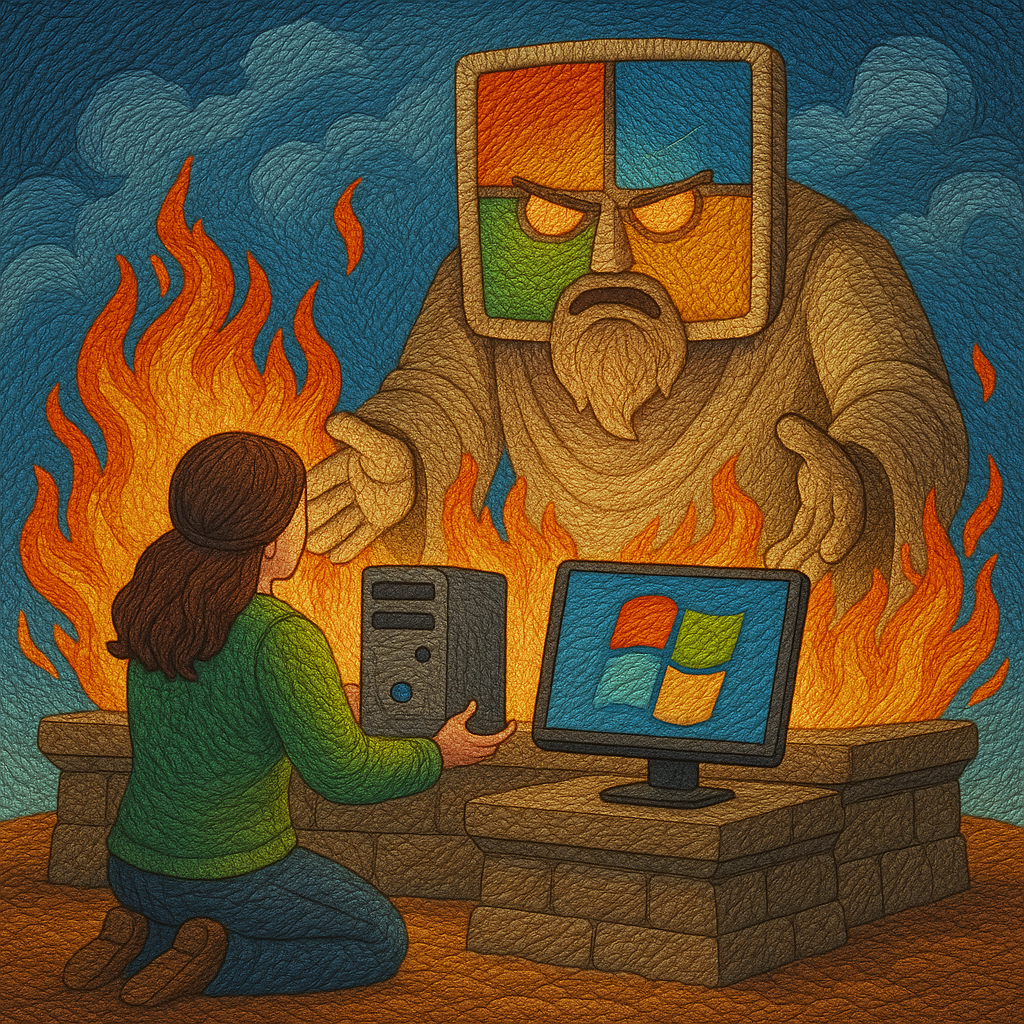
Have you read The Internet is Made of Demons?  Yeah… if that’s true, my computer is 100% possessed.

This beast didn’t even start life as a “normal” desktop. It was literally the guts of a lottery terminal. (I wish I was joking.) Windows 11 took one look at my hardware and said, “Absolutely not,” so I’ve been happily coasting along on Windows 10. But now that Win10’s support is on its last legs, I’ve been out here like some wannabe hacker, trying every shady workaround I can find to sneak past Microsoft’s hardware checks. Everyone online swears they “know a guy” who pulled it off. Spoiler: nothing works.

And maybe - just maybe - my pure rage opened a portal for the demons.

First, my audio started freezing during calls. Friends swore it was “just a driver.” Tried everything. Nada. Then my video joined the party. Next, random USB ports started flaking out like they were auditioning for a horror movie. Suddenly, I’m sitting here wondering if an upgrade to Windows 11 would fix it. (Why? Why would I even think that? Like Microsoft suddenly wants to save me?)

No, I’m not buying new hardware just to appease the MS gods.

ChatGPT Image Jul 27 2025 10 19 28 AM

You should know: this thing has 14 USB ports. Fourteen. Do I use them all? Absolutely not. But I went from two measly ports on my laptop to this glorious buffet of connectivity, and I’m not giving it up. It’s rocking 32 gigs of RAM and has always been a solid little workhorse… until, you know, the possession.

So, I pulled a bold move: I swapped the motherboard with another one just like it and went full-on Linux. Yep, I jumped ship. I’ve used Linux before, but I missed PaintShop Pro too much to stick with it. But now? I’m running Linux Mint with Cinnamon, and thanks to ChatGPT’s hand-holding, I even set up a virtual Windows machine so I can use PSP.

Linux has come a long way since the old Red Hat days (shout-out to anyone who remembers that chaos). It’s smooth, pretty, and - so far - I’m not looking back. Well, except for one thing: headsets.

Turns out, my fancy SteelSeries Arctis 5 USB headset and my bone-conduction Shokz OpenCom2 (both amazing on Windows) decided they hate Linux. After many, many hours of cursing at forums and trying every workaround, I finally learned:

“Both mics don’t work in Linux because their advanced USB audio drivers aren’t fully supported. They’ll show up as headphones, but the mic isn’t recognised.”

Translation: buy a new headset or get creative.

So yeah, I’m dropping cash - not for Microsoft’s ransom, but because my gear doesn’t vibe with Linux. Worth it. And honestly? If you’re still on Windows 10 and wondering what to do next, try Linux. It might surprise you.

Until next time friends...


teddy bear

Inclusivity, Identity, and the Meaning of a Safe Space

I’ve spent the past six months building a home for the Fiberarts Community, and honestly, I feel like I’m rebuilding myself in the process. A big part of this journey has been about understanding others, seeing things from their perspectives, and reflecting on my own views.

Tonight’s internal topic was “inclusivity and creating a safe space.” Earlier, I attended an event on my favorite platform, GoBrunch. I had to step away for a bit, and when I popped back in, I landed right in the middle of a lively discussion: “Should people use their real names and photos on LinkedIn?”

It’s a topic I’d heard mentioned before but never really explored. I’ve been “Artemisnorth” for as long as I can remember—it’s my brand, my identity online. Even my husband calls me his “Goddess Artemis.” I don’t hide who I am, but I choose who I share my legal identity with.

The host of the event, someone I’ve known for a while, is known for sparking these kinds of conversations. As usual, I found myself in the proverbial “hot seat.”

“Okay, stay calm, don’t swear…” I thought. I shared my perspective, the host moved on, and my gears started turning. Why should it matter if someone uses a pseudonym or a different image? How does that affect creating a safe space? And how does it make me feel?

Someone in the discussion said, “People who don’t use their real name or picture must have something to hide.” That hit me hard. Do I have something to hide? No, I don’t believe I do. But suddenly, I found myself questioning everything.

Then it clicked. I was forgetting who I am. I was letting others’ expectations affect how I see myself. And that’s when I realized how this discussion was making me—and others—feel. It wasn’t a “safe space.”

Projecting our own views or expectations onto others only creates tension. Inclusivity isn’t about making everyone fit into the same box. It’s about ensuring people feel they can be their authentic selves, connect meaningfully, and truly belong.

It’s not just about creating a space—it’s about building a culture of understanding, respect, and genuine connection.

Until next time friends...

think

My First London Pride Parade!

Hey everyone! I want to share a little story about how my daughter and I unexpectedly found ourselves at Pride this year. We had planned just to hang out downtown, completely unaware that it was the day of the Pride parade. I only realized it when my bus had to take a detour.

Stepping off the bus, I noticed the stormy sky and hoped to dodge the rain. My daughter had the same thought and suggested we wait it out at a new coffee shop. Though I can't recall its name and forgot to snap photos (oops!), the place was lovely, and the iced tea was fantastic! I was just so excited to catch up with my daughter after weeks apart that the name of the coffee shop slipped my mind.

We sat there, chatting away and sipping our drinks, watching others get caught in the rain and sharing a laugh about our good fortune. When the rain let up, we decided to brave the parade, confident we wouldn't melt in the drizzle.

Approaching the parade route, we were greeted by a sea of colourful, cheerful people, undeterred by the rain. The atmosphere was vibrant with music and laughter, but there were a few protesters too, with police nearby ensuring everything stayed peaceful. Interestingly, off-duty officers were also part of the parade, donning pink shirts and looking quite cute!

The parade was a celebration of peace and love, and it was heartwarming to see everyone so happy and friendly. It's a shame that some people can't move past their prejudices, but hey, all that negativity can't be good for anyone. Once the parade started, the music and cheers drowned out any dissenting voices.

scouts canada

I admit, I didn't take many photos – I was just so caught up in the fun and excitement! People were dancing, handing out beads and candies, and no one minded getting a bit wet from the Super-Soakers and mist sprayers on the floats. The atmosphere was incredibly positive and inclusive.

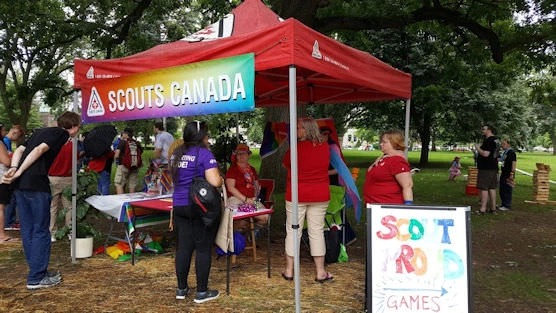
It was amazing to see groups like the Teacher's Union and Scouts, who might not have participated a decade ago, now fully embracing the event with bright colours and high spirits. It's a sign of growing acceptance, and it gives me hope for the future in other areas like race and ethnicity.

The parade ended with a much-anticipated appearance by the firemen – let's just say, they did not disappoint! As the crowd dispersed, my daughter and I strolled through Victoria Park, taking in all the sights and booths. It was a day where the extraordinary became ordinary, and it made me wish every day could be that open and accepting.

Eventually, real life called, and we parted ways, feeling happy and content to have shared such a wonderful experience. I'm definitely planning to be back next year, and who knows, maybe I'll join in and deck myself out too!

Until next time friends...

happy pride