
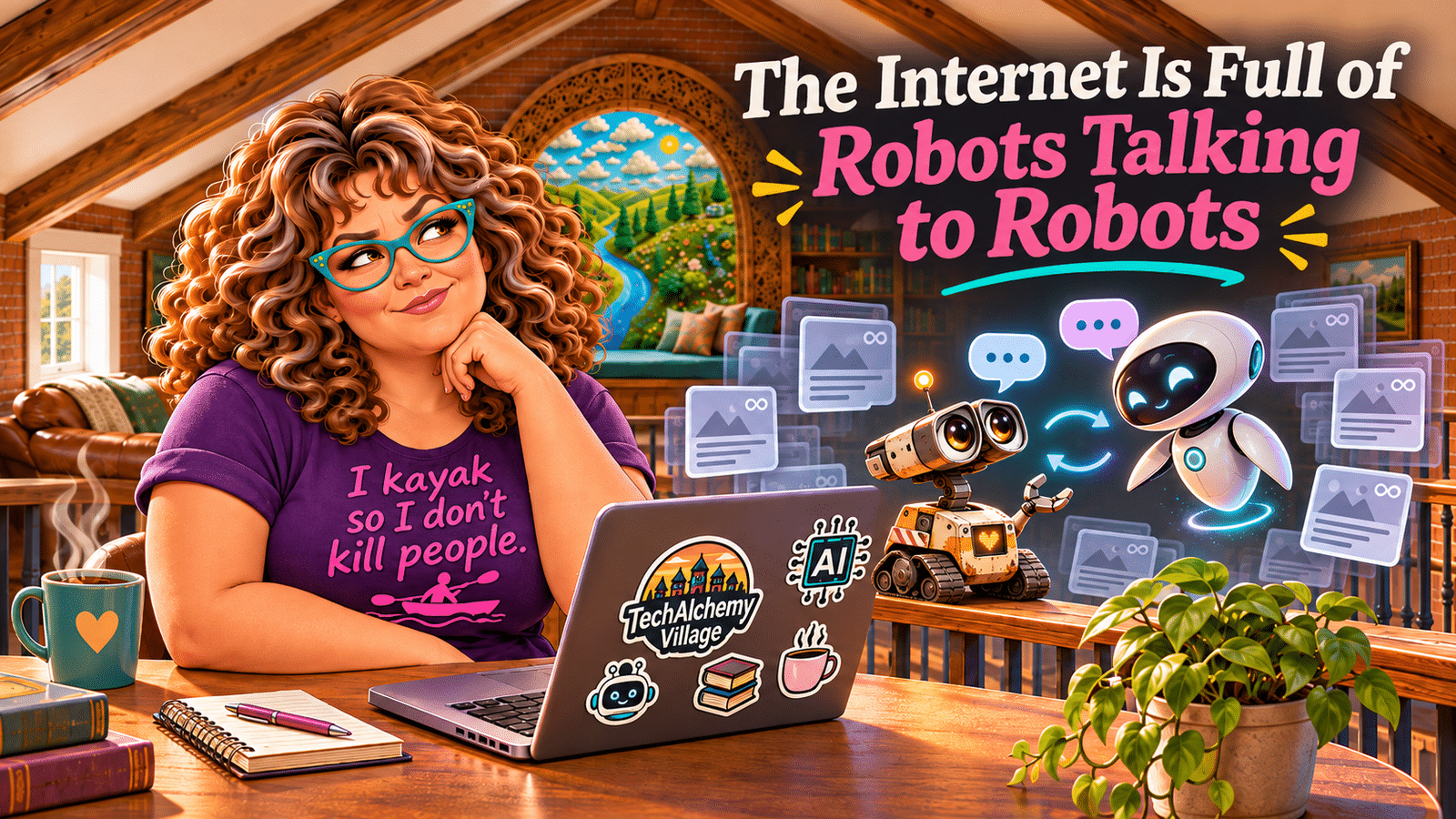
I've been getting increasingly irritated with the amount of AI-generated garbage flooding the internet.
There. I said it.
Yes, I'm aware of the irony. I'm writing this with the help of ChatGPT. I use AI extensively, and I happen to think it's one of the most extraordinary tools we've ever had.
So why does so much AI-generated content drive me up the wall?
Turns out I wasn't angry about quite what I thought I was.
A Beautifully Written Pile of Nothing
You know those articles. The headline promises something fascinating. The introduction sounds intelligent. There are tidy headings, impressive claims, and plenty of thoughtful-sounding observations.
You keep reading, expecting to learn something.
Then you reach the end.
Nothing.
Not one interesting insight. Not one meaningful example. Just a thousand beautifully arranged words that somehow managed to say absolutely nothing.
Ten minutes of your life you'll never get back.
Somebody apparently decided the first plausible collection of AI-generated words was good enough to publish. Congratulations. You've contributed another bucket of nothing to the internet.
Of course, people were publishing rubbish long before AI arrived. We've simply developed technology that makes producing it astonishingly easy.
I'm not opposed to rubbish on principle, either.
Have you seen those ridiculous multipart TikTok stories where narrators change accents, characters mysteriously change identities, and the plot apparently went out for cigarettes three episodes ago?
They're Sharknado terrible. So awful they're entertaining.
There's a difference between knowing you're consuming nonsense and being handed nonsense that's pretending to be knowledge.
Artificial Authority: Now Available in Bulk
The phrase that finally made everything click was artificial authority.
Not artificial intelligence. Artificial authority.
People presenting themselves as knowledgeable experts when the substance behind their claims doesn't match the impressive presentation.
The worrying part is that polished nonsense doesn't always look like nonsense. Sometimes it arrives dressed in impressive terminology, delivered with all the confidence of someone who's never been wrong a day in their life.
I've followed authors whose writing seemed insightful, only to discover that the incredible system they were selling was a basic worksheet dressed up like the second coming of productivity.
There's nothing wrong with a basic worksheet. Simple solutions can be valuable, especially when you're just starting out.
Just tell me it's a worksheet.
Don't sell me the ULTIMATE LIFE-CHANGING SYSTEM and hand me something that looks like it was produced during a coffee break.
I'm Canadian. I'll probably be polite about it.
I'll remember, though.
Well, That's Inconvenient
Bob, my occasionally infuriating AI companion, has earned the affectionate title of "jackass" for making me question myself.
During our discussion, he asked me something uncomfortable.
What if an article was entirely AI-generated but accurate, thoughtful, well researched, and genuinely useful?
Would it suddenly become worthless because a human hadn't written it?
Well, damn.
No.
I had to admit I'd probably read some excellent AI-generated writing without even realizing it.
So much for my righteous indignation. Apparently, I needed to question a few of my own assumptions before criticizing everyone else's.
The problem wasn't simply who wrote the words. It was whether the information had value, whether the person presenting it was honest about their knowledge, and whether they took responsibility for publishing it.
Rather inconvenient when you've started out wanting to complain about robots.
Apparently, questioning your own argument can be hazardous to a perfectly good rant.
Whatever Happened to "I Don't Know"?
I loved science experiments in high school. You started with a question, developed a hypothesis, experimented, and examined the results.
Sometimes you were right. Sometimes spectacularly wrong. Both taught you something.
Years later, doing legal research for a law firm, I had to find precedents supporting the position we were investigating.
I also had to find those that worked against it.
Imagine that. Deliberately looking for evidence that might prove you wrong.
Yet it's remarkably easy to surround ourselves with information that agrees with us. Ask AI for an argument supporting your position, and you may get a wonderfully convincing one.
What happens if you never ask for the opposing argument?
When something matters to me, I try to follow the information back to its source. Then I look for evidence that might challenge it.
Sometimes that means discovering I was wrong.
Delightful. Another perfectly good opinion ruined by evidence.
Somewhere along the way, "I don't know" seems to have become something people are afraid to admit.
Everybody has an answer. Everybody has a system. Everybody is an expert.
Apparently nobody is still figuring things out.
Which is remarkable, because I've been figuring things out for nearly sixty years, and I'm nowhere near finished.
Is Anybody Actually Talking to Anybody?
So much online content seems designed to satisfy algorithms, maintain posting schedules, and generate clicks.
Someone uses AI to produce content.
Someone else uses AI to generate a response.
Algorithms measure the activity.
Everybody congratulates themselves on their engagement statistics.
Lovely.
We've automated the writing, automated the responses, and found ways to measure all that wonderful activity.
Somewhere in there, apparently, we're supposed to be building relationships.
Is anybody actually talking to anybody?
Writing has always been part of how I figure things out. I'll start with something I think I understand and discover halfway through that I don't understand it nearly as well as I thought.
Sometimes I change my mind. Sometimes I discover an entirely different question hiding underneath the first one.
Occasionally there's a little tantrum before the learning happens.
Personal growth isn't always peaceful.
The humour usually comes later.
It's a Poor Craftsman Who Blames His Tools
My dad used to say, "It's a poor craftsman who blames his tools."
After decades working with fibre arts, experimenting, learning techniques, and occasionally producing something that looked nothing like the picture, I understand what he meant.
The tools matter. What we learn to do with them matters more.
AI is an extraordinarily powerful tool. I've used it to build systems, organize my business, and free up time for things I genuinely enjoy.
I'm certainly not suggesting we abandon technology and return to dragging things around on wooden sleds.
However, unlike a knitting needle, AI can produce something that sounds completely authoritative even when it's wrong.
Just because something sounds right doesn't mean it is. Just because something feels wrong doesn't mean it is, either.
Our instincts aren't proof. They're a reason to ask another question.
I figure if I'm publishing something with my name attached, I ought to make an effort to understand it.
Revolutionary concept, apparently.
Readers have a role in this, too. We don't have to investigate every silly thing we encounter online. Lord knows I've willingly watched enough ridiculous TikToks to prove that.
Yet when something matters, accepting a convincing answer simply because it agrees with us can be a costly mistake.
Sometimes the most useful question is "What might I be missing?"
The Chaotic Beauty of Not Having Everything Figured Out
We've become awfully good at presenting tidy, buttoned-up versions of ourselves online.
Successful businesses. Perfect routines. Carefully crafted authority.
Apparently it's not enough to have our lives together anymore. Now we need to make sure the internet thinks we do, too.
Meanwhile, actual life is a chaotic bloody mess.
I wish more people would share that part. The experiments, mistakes, uncertainty, and discoveries that happened because something didn't work.
Some of the most memorable things I've read made me stop and think:
"HOLY COW! I DO THAT!"
I might not remember the author or the article, but I remember what it helped me discover about myself.
That's the kind of value I'd like to share.
So, Are the Robots Taking Over?
I don't think AI is the villain here.
People have been exaggerating, misleading, manipulating, and pretending to know more than they do for a very long time.
AI didn't invent those behaviours. It just made some of them much easier to scale.
It's also opened extraordinary opportunities to learn, experiment, and create.
I'm living proof of that.
Here's the funny part.
This article began as a conversation with AI about how annoyed I am with AI-generated content.
Bob challenged my assumptions. I challenged his. We argued, reconsidered, and wandered through enough philosophical rabbit holes to populate a small wildlife sanctuary.
Somewhere along the way, I changed my mind about a few things.
I learned.
And isn't that the whole point?
I don't want people to fear AI.
I don't want them to stop using tools that can make their lives easier.
I want them to remain curious.
To question what they're told, even when it sounds convincing.
To examine beliefs they've held for years, even when discovering they're wrong is uncomfortable.
To recognize that "I don't know" is often the beginning of something interesting, not something to be ashamed of.
And maybe, just maybe, to remember that behind all the articles, posts, algorithms, and automated conversations, there are supposed to be actual human beings.
We're not always tidy.
We're not always right.
We certainly don't have everything figured out.
We can keep questioning, experimenting, learning, and talking to one another.
And if we can manage that?
Maybe my daughter will finally stop looking at Alexa like she's Skynet waiting to take over the world.
Until next time Friends...