
Tulip Crochet Hooks – A Happy Review

by artemisnorth | Aug 15, 2019 | uncategorized | 0 comments

There comes a point in far too many small business websites where the whole thing stops feeling like a useful tool and starts feeling like the kitchen junk drawer.

You know the one.

You open it looking for one thing and suddenly you’re elbow-deep in dead batteries, mystery keys, elastic bands, expired coupons, two pens that do not work, and a screwdriver that apparently lives there now for reasons no one can explain.

That is a lot of small business websites.

And if your website feels weirdly hard to update, manage, or trust, the problem may not be you. It may be that the site has become cluttered, outdated, or structurally messy over time.

You go in to fix one tiny thing. Change a sentence. Swap a button. Update a date. Add a link. Nothing dramatic.

Cute.

Forty minutes later, you’re wandering through old pages, duplicate drafts, weird settings, mystery plugins, and images named things like final-final-2-reallyfinal.jpg, wondering which version of past-you made these choices and why she was allowed near the controls.

That is not a discipline problem.

That is a structure problem.

When your website starts fighting back

A lot of people assume website stress means they are disorganized, bad at tech, behind on everything, or somehow failing at adulthood.

Usually, that is not what is going on.

Usually what happened is much less dramatic and much more annoying.

The website grew.
The business changed.
Offers shifted.
A new page got added.
A tool got bolted on.
Something broke.
Something got patched.
Something got ignored because you were busy and it seemed fine enough at the time.

Which, to be fair, is how a lot of business decisions get made when you are one person trying to do seventeen jobs and occasionally eat lunch.

So no, this does not mean you ruined your website.

It usually means the site has been collecting layers.

And layers create friction.

Not all at once. Just steadily. Quietly. Like digital plaque.

What a messy small business website actually looks like

The sneaky part is that it does not always look terrible from the outside.

Sometimes the homepage still looks perfectly decent. Sometimes the branding is nice. Sometimes the site even works well enough that nobody is actively screaming.

The trouble usually shows up behind the scenes.

It looks like this:

  • too many old pages hanging around because you are afraid to delete the wrong one
  • blog categories that made sense once and now mostly raise questions
  • plugins you no longer use but do not quite trust yourself to remove
  • settings buried in seventeen different places for no good reason
  • duplicate images and mystery files breeding quietly in the media library
  • pages you avoid editing because every time you touch them, something gets weird
  • a backend that turns every “quick update” into a whole production

And here is the part that matters:

When your website is hard for you to manage, it often becomes harder for visitors to use too.

Not always in a big flashing-error way.

Sometimes it shows up as clutter, confusion, inconsistency, dead ends, outdated information, missing context, or just that faint but unmistakable feeling of, “Hm. Something here is a little janky.”

People may not know exactly what is off.

They just feel the drag.

The hidden cost of website clutter

A website junk drawer does not just waste time. It eats momentum.

Every small update starts to feel mildly cursed. You put things off, avoid publishing, and start dreading tasks that should be simple.

That is the real cost.

Not just the mess itself, but the mental drag of a tool that quietly trains you to avoid using it.

That is how a business website turns into background stress.

It is the same kind of low-grade friction that shows up in other parts of running a business too. Small things are not always small when they keep draining time, attention, and energy. You can explore more of that in the Business & Workflow section of the site.

Why simple website cleanups turn into bigger jobs

Sometimes you think you are doing a quick little website tidy.

Delete a few things. Clean up a page or two. Be responsible. Feel accomplished.

Adorable.

Because once you start pulling at the threads, you often realize the clutter was not the whole problem.

The clutter was just sitting on top of bigger structural issues.

Old content overlaps with current offers.
Page hierarchy stopped making sense somewhere around three pivots ago.
Images are missing proper names or alt text.
SEO details were never actually finished.
Accessibility got patchy.
Navigation evolved by accident instead of on purpose.

So what looked like a bit of housekeeping turns into a real audit.

Annoying? Yes.

Useful? Also yes.

Because now you are finally seeing what the website has been trying to tell you with all its weird little acts of resistance.

I wrote about that kind of domino effect more directly in How a Website Cleanup Turned Into an SEO and Accessibility Audit.

Signs your website needs a cleanup

Here are a few.

Small edits take way too long

You should not need a snack, a pep talk, and a support ferret to update one section of a page.

You are never fully sure what is live

If you have to squint at your own website like a suspicious Victorian aunt, something is off.

You keep finding outdated pages or half-finished bits

That usually means the site has grown without a clean structure underneath it.

You avoid touching parts of the site

Not because you are lazy. Because you do not trust what will happen if you breathe on them.

The backend feels heavier than it should

Too many decisions. Too many steps. Too many places for things to hide and wait for you like little goblins.

If several of these sound familiar, you do not have a motivation problem.

You have a website friction problem.

What to do first

You do not need to fix the whole thing in one dramatic burst of digital righteousness.

Please do not do that to yourself.

Start smaller.

1. Figure out what actually matters now

What pages, offers, and content are still relevant to the business you have today?

Not three rebrands ago. Not two pivots ago. Not that lovely idea you had in a fit of optimism and never fully used.

Now.

2. Identify the obvious clutter

Old pages. Duplicate drafts. Unused images. Abandoned ideas. Expired announcements. Offers you do not even want anymore.

You do not have to delete everything immediately. This is not a purge montage.

But you do need to know what is taking up space.

3. Map the core structure

What are your main pages?
What do visitors most need to find?
What do you most need to update regularly?

That gives you a practical picture of what the site is actually supposed to support.

4. Notice where you feel resistance

Which tasks always feel more annoying than they should?

That is usually where the mess is costing you the most.

Pay attention to the spots that make you sigh before you even click. Your nervous system knows things.

5. Stop treating every website problem like a personal flaw

A messy website is usually what happens when a real business grows in real time and nobody gets around to rebuilding the plumbing because they are busy trying to run the actual business.

That is not a character defect.

That is maintenance catching up with you in ugly shoes.

Your website is supposed to support the business

Not haunt it.

Not confuse you.

Not punish you for trying to update a sentence.

A website does not need to be perfect. It does not need to be massive. It does not need a thousand bells, whistles, and dashboard goblins demanding snacks.

It does need to be usable.

Clear enough that visitors can find what they need.
Clean enough that you can manage it without losing the will to live.
Structured enough that it supports the business instead of creating more drag around it.

That is the real goal.

Not perfection.

Usability.

Because a business website should feel like a tool.

Not an escape room.

Final thought

If your website feels harder to manage than it should, the answer is probably not to shame yourself into “being better at it.”

The answer is to look at the structure, the clutter, the outdated bits, and the friction points, and start untangling what is actually going on.

Because your website should not feel like a drawer full of mystery wires, expired coupons, and decisions made by a sleep-deprived raccoon.

It should feel like something you can use without needing emotional backup.

And honestly, that is not asking too much.

If your website feels harder to update, manage, or trust than it should, that is exactly the kind of mess I help untangle in TechAlchemy. Get in touch here and we’ll look at what is clutter, what is broken, and what to fix first.

jackie

Tulip Crochet Hooks! These are, in my opinion, the BEST crochet hooks on the market. Drool worthy to say the least. I've wanted a set for quite some time but they aren't cheap. I finally had the money to order them but there was a problem with shipping so they were refunded. The refund ended up in the household budget and I continued to drool.

For my birthday last month my friend, Jackie, surprised me this set of Tulip lace crochet hooks! THANK YOU JACKIE!! She'll probably shoot me for sharing this pic but honestly it's my favorite shot of her. She's quite the Lady.

What's so great about these crochet hooks?

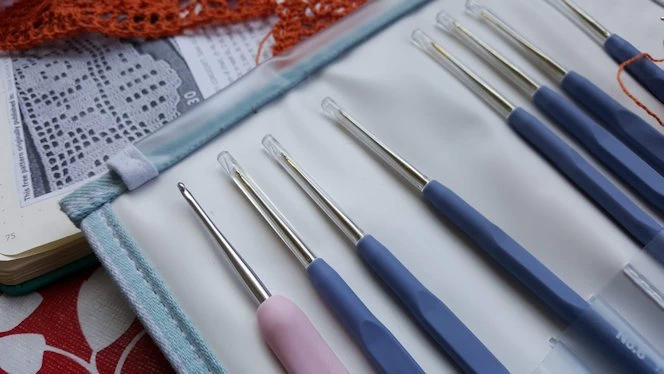
For me, it's all in the handles. I've spent many hours crocheting with tiny steel crochet hooks. As I'm getting older I find my fingers cramp. Those tiny steel shafts are hard to grip for any amount of time. The Tulip crochet hooks have a beautifully shaped handle made out of a firm yet soft texture that is very comfortable to hold.
close up

The hooks themselves are smooth and well shaped. I love the little covers on each hook. This not only protects those tiny hooks but it also keeps them from hooking on items in your project bag. My project notes are now safe from holes and tears from those little hooks.

rolled up

This sweet set comes with a beautiful roll up case, scissors, a small measuring "stick" and two needles for sewing in the ends. The little accessory pocket also holds my tatting shuttle and stitch markers. The only issue with this set is that it doesn't come with a 2.0mm hook which is a common size for lacework. This is easily remedied by purchasing one and adding it to the several empty spots in the case. Problem solved.

The Tulip Lace set has a nice range of hook sizes from 0.05mm up to 1.75mm which can be hard to find. My Mother gave me the steel set I've been working with all these years and those originally belonged to my Grandmother. Can you tell I'm excited about these hooks?

When I brought these hooks home I couldn't wait to use them. I took out various crochet cotton threads and played around, loving every second of it. My mind was racing as to what I would create with them. I started thinking about Jackie, how amazing she is and how could I express my thanks, when it hit me that I had the perfect thread to make her a birthday gift.

In the 90's my Mom made lace edging which she sewed onto a set of sheets for @shadowspub. They were beautiful. When Mom passed I inherited her "stash" which contained a new ball of that earthy, coral color. Perfect! In fact I've seen Jackie wear this color tone quite often.

About a year or so ago Jackie and I were looking at lace patterns and one caught her eye. It was "Summer Splendor". I think the only reason I remember this is that she "oohhed and awwed" over it, talking about what color she would do it in. Somewhere during our chat we moved on and it was forgotten. I printed the pattern off of Ravelry and eagerly began to crochet.

It's amazing how much more enjoyable a project can be when you are using good quality tools. Between getting to know my hooks and using that beautiful coral color full of memories, I was in heaven.

doily

Jackie loved it and was so happy that "a gift made a gift". It's proudly displayed in her dining room.

My next little project was simple lace edging for pillow cases. Using the same coral cotton I found a very old pattern and proceeded to interpret it:

trim

I'm guessing this pattern is from the Victorian era. It's actually not very hard once you transcribe the terms used into today's lingo. I believe the pattern is well past copy right so if you are interested in this pattern drop me a comment and I'll share it with you.

Needless to say my zest for lace making has been renewed. Thank you Jackie! At the moment I'm working on a fun and colourful Unicorn stuffie for my Granddaughter's 1st birthday. After that? I'll keep you posted but I'm guessing there's lace work in my future.

Until next time friends...

bitmoji stay tuned

Untangling tech for the creative brain.

I help neurodivergent makers and anyone dealing with tech-stack or workflow chaos clear digital clutter and build practical systems that actually work. 1:1 consulting and community co-working to help you get unstuck and finish what matters.

Let’s sit down 1:1 and build a workflow that actually works.
Drop into my Office anytime. If I’m online, I’ll greet you. If not, leave a note and I’ll get back to you.