Fiber Arts, Ethical AI, and Why My Assistants Can’t Knit Socks

I recently attended the Global Business Plaza and sat in on a session called Ask Peggy. As always, Peggy makes us think whether we like it or not. That conversation stayed with me and made me realize I need to be much more vocal about how I use AI and what its ethical use looks like in my world.

When I revamped Artemis North, I talked a lot about services and tech. However, I realized I left out the most important part: I don’t do this alone. As a fiber artist, I am all about the tactile. I want to feel the wool, see the way the light hits indigo, and get lost in the texture of it all. But being a late-diagnosed ADHD creative means I also have "The Boulder." You know the one. It sits on your neck, whispers that you have eighty-seven unread emails, and effectively paralyzes you until you are just staring at a wall instead of making your art.

Enter Pip, Bob, and Jim.

Pip, my alpaca mascot, is the soul of the operation. He represents the soft, creative dream. But let’s be real: Pip doesn't have thumbs, and he is terrible at spreadsheets. That is where Bob (ChatGPT) and Jim (Gemini) come in. They are my left and right hands. They are not here to replace my soul; they are here to be my dev team, my marketing department, and my "thought detanglers."

The Elephant in the Room

Someone asked me today, "Does AI write your posts?

The truth is: I love to write. I have spent a lifetime developing my "Fiberarts style" by painting pictures with words. I use AI for suggestions, to tighten my grammar, and to catch the spelling errors my racing brain misses.

But AI does not have a soul yet, and it certainly does not have a sole. I am pretty sure Jim could not knit a sock to save his life. AI does not do the dreaming. Pip handles that. Bob and Jim just help me clear the wreckage so I can finally get to the dreaming.

Sometimes, the Best "AI" is No AI at All

I will be the first to admit I get "shiny-object syndrome." Recently, I was convinced I needed a tool called Moltbot to automate my chaotic inbox. I thought I needed a complex AI solution to save me from the email boulder.

But then I sat down and looked at the tools I already had. It turned out Gmail was already powerful enough; I just had not "tuned" it yet. I did not need a bot; I needed a system.

A Mini-Alchemy Win: How to "Moltbot" Your Gmail

If you are drowning in newsletters and clutter, here is the exact move I used to clear my head:

* Spot the Noise:* In your Gmail search bar, type label:unread to see what is mocking you.

The "Waiting Room" Strategy: Click the three dots on a newsletter and select "Filter messages like these."

The Magic Sequence: Select "Skip the Inbox (Archive it)" and "Apply the label." Create a label called "Read Later."

The Result: Now, those emails go straight to their "room" instead of pinging your phone. You check them when you have the energy, not when they demand it.

Let’s Unblock the Magic Together

This is what I want to teach you. Not just "here is a cool robot," but how to look at your workflow, find the bottleneck, and shove that boulder out of the way. This works whether you use a high-tech assistant or a simple filter.

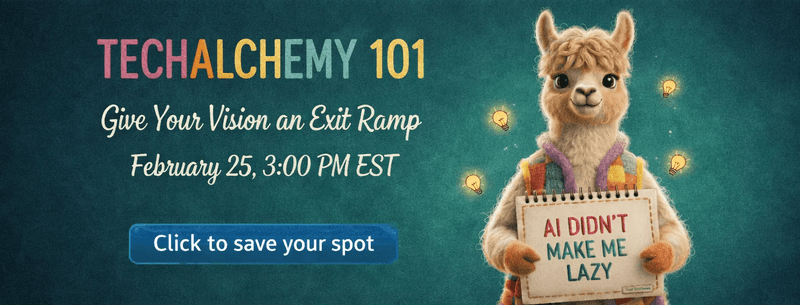
If your brain feels like a tangled skein of yarn, come join me for TechAlchemy 101. We are going to find the specific, simple tools that give you your time back. I have been there, I am still there, and I have a spare seat at the table and a very fluffy alpaca waiting for you.

Come get unblocked at TechAlchemy 101

Until next time friends...
poster banner

The Laundry Room Epiphany: How a Washing Machine Taught Me to Love AI

Let’s be real for a second: if you saw me standing over a galvanized tub in the backyard, scrubbing my jeans against a metal washboard until my knuckles bled, you wouldn’t call me a “purist.” You’d call for help. You’d ask me why on earth I’m making life ten times harder than it needs to be when there is a perfectly good Maytag sitting in the laundry room.

Yet, when it comes to AI, that’s exactly where many of us are stuck. We’ve been told that using these tools is "cheating." We’ve been fed this narrative that if it isn't a struggle, it isn't "real" work.

This past Monday, I was typing up a post about exactly this. I was fired up, explaining that AI isn't some robot takeover; it’s just the modern washing machine for our mental load. Sure, you could do everything by hand-the research, the formatting, the brainstorming-but it’ll wear you out and leave you too exhausted to actually enjoy the clothes you just cleaned. Or, in our case, the art you just made.

As I hit "publish," a little lightbulb went off. I realized that just talking about the "laundry" wasn't enough. I needed to be part of the solution. I needed to show people how to actually use the machine.

The "One-Human Team" Struggle

As a Gen X creative, I grew up in the era of "figure it out yourself." But here’s the rub: mainstream companies have entire floors dedicated to what I’m trying to do at my desk. They have a design team, a dev team, a marketing team, and probably a person whose entire job is just "Strategy."

I have me. I have my computer, my art, and a very supportive husband-but none of them are going to write my curriculum or build my landing pages for me.

For years, I’d start a brilliant project and then hit "The Wall." You know the one. It’s built out of the boring-but-necessary tasks that make our neurospicy brains want to exit the building. The admin, the micro-details, the sheer volume of steps required to bring a vision to life. My brain would glitch, overwhelm would set in, and another "cool idea" would end up in the graveyard of half-finished dreams because I just couldn't focus on the "boring" parts.

Finding the Magic in the Machine

Enter my new "team": Jim (Gemini) and Bob (ChatGPT).

In the few days since that Monday epiphany, I’ve been on a total learning adventure. Instead of AI telling me what to do-which is the exact opposite of how this works-I used these tools to find my weak spots. I used them to understand how my brain actually wants to flow and to find tools that handle the bits that usually cause me to shut down.

With Jim, Bob, and my own beautiful, chaotic brain working in tandem, I’ve managed to create a hands-on, one-hour workshop from scratch. I’ve even been in the virtual trenches, altering my workshop room in The Makers' Community to make sure the space feels just right for what’s coming.

Is it 100% finished? Nope. There’s still more work to do and some digital dust to sweep up, but for the first time, I’m not sweating it. I’m confident I’ll be ready in time because I’m not scrubbing the floor with a toothbrush anymore. I have help, I have direction, and I’m actually achieving the goals I set.

Join Me in the Lab

I’m so excited to share this "TechAlchemy" with you. It isn't about becoming a tech bro or chasing "hustle culture." It’s about making the tech work for us-the makers, the fiber artists, and the thinkers who just want to get our magic out into the world without the soul-crushing overwhelm.

I’m pulling back the curtain so you can see exactly how I use these tools to bridge the gaps in my focus and keep my creative momentum alive. No shame, no "bro-marketing" pressure, and absolutely no judgment-just a warm, friendly seat at the table to see a "neurospicy" tech guide in action.

If you’re curious about how to turn your own creative "laundry list" into something manageable (and maybe even fun), I’d love to see you there.

Click here to see the details and grab your spot!

How does this feel for your "sassy but warm" vibe? If you like it, would you like me to help you draft some "behind-the-scenes" image prompts for your workshop room to use in the post?

Until next time friends...

poster

AI Didn’t Make Me Lazy. It Made My Vision Possible.

There’s a "spicy" little myth floating around that using AI is "cheating". The narrative suggests you’ve simply outsourced your soul, kicked your feet up, and are lounging in a silk robe while a robot does the heavy lifting.

First of all: hilarious. Second: if you saw the sheer volume of my "neurospicy" to-do list, you’d know AI didn’t make me lazy. It made me able to finish things.

The Executive Function Tax

As a creative with a loud imagination, ideas have never been my problem. I can see the "brain-movie" of a finished project-the vibe of a space, the structure of a workshop, the flow of a landing page-long before it exists

My struggle is the bottleneck. It’s the 18-step obstacle course between "in my head" and "in the real world". It’s the tabs, the half-drafts, and the "I’ll come back to this later" pile that inevitably turns into a digital junk drawer with legs.

For me, AI isn’t the creator. I am the creator. AI is the translator-the assistant that helps me get the vision out of my brain before it evaporates.

From Brain-Movie to Concrete Reality

When people say AI makes things "too easy," I have to ask: Easy for whom?. The hard part isn't typing; it’s pulling the right words out of the fog while juggling ten jobs and an ADHD brain that’s playing the "where did I put that important thing" game on hard mode.

AI helps me do the part that drains me so I can do the part that lights me up.

  • It reduces friction: Taking a chaotic brain dump and turning it into a structured plan, a script, or a checklist.
  • It provides accessibility: Using a tool to lower the "starting cost" of a task isn't a moral failure-it's building a digital wheelchair ramp for your mind.
  • It prevents burnout: Efficiency is what keeps you from rage-quitting your own dreams.

Taste is the Anchor

AI can generate a lot of content, but most of it is "beige"-like unseasoned chicken. It lacks your lived experience, your humor, and your "nope, that’s not it" radar.

I still steer the ship. I decide what is aligned and what is "corporate nonsense". If anything, AI has made my voice clearer because it forces me to articulate exactly what I mean. I’m constantly refining, defining, and putting my personality in on purpose.

Building a Team (Without the Payroll)

The biggest shift has been treating AI like a diverse department rather than a single tool. Running a creative business means you're wearing fifteen hats at once:

  • **The Copywriter**: Tightening captions and brainstorming hooks.
    
  • **The Dev Assistant**: Troubleshooting tech without spiraling into ten open browser tabs.
    
  • **The Brand Strategist**: Refining messaging to ensure it makes sense to people who don't live inside my head.
    

I am still the Director. AI isn't running my business; it’s helping me run it so I can actually remember to do things like "drink water".

Systems Beat Willpower

Working with AI is a learned skill, not magic. It’s about iteration-learning how to give better direction, provide context, and shape the output until it clicks.

My visions were never the problem. The bottleneck was. I’m not using AI because I don’t want to do the work; I’m using it because I want the ideas in my head to become real tools people can use and art they can connect with.

AI didn't make me lazy. It gave my vision a way out.

Until next time, friends...