Knit Happens… Even If It Starts with Just Me

by artemisnorth | Dec 16, 2024 | Maker Life / Fiberarts | 0 comments

There comes a point in far too many small business websites where the whole thing stops feeling like a useful tool and starts feeling like the kitchen junk drawer.

You know the one.

You open it looking for one thing and suddenly you’re elbow-deep in dead batteries, mystery keys, elastic bands, expired coupons, two pens that do not work, and a screwdriver that apparently lives there now for reasons no one can explain.

That is a lot of small business websites.

And if your website feels weirdly hard to update, manage, or trust, the problem may not be you. It may be that the site has become cluttered, outdated, or structurally messy over time.

You go in to fix one tiny thing. Change a sentence. Swap a button. Update a date. Add a link. Nothing dramatic.

Cute.

Forty minutes later, you’re wandering through old pages, duplicate drafts, weird settings, mystery plugins, and images named things like final-final-2-reallyfinal.jpg, wondering which version of past-you made these choices and why she was allowed near the controls.

That is not a discipline problem.

That is a structure problem.

When your website starts fighting back

A lot of people assume website stress means they are disorganized, bad at tech, behind on everything, or somehow failing at adulthood.

Usually, that is not what is going on.

Usually what happened is much less dramatic and much more annoying.

The website grew.
The business changed.
Offers shifted.
A new page got added.
A tool got bolted on.
Something broke.
Something got patched.
Something got ignored because you were busy and it seemed fine enough at the time.

Which, to be fair, is how a lot of business decisions get made when you are one person trying to do seventeen jobs and occasionally eat lunch.

So no, this does not mean you ruined your website.

It usually means the site has been collecting layers.

And layers create friction.

Not all at once. Just steadily. Quietly. Like digital plaque.

What a messy small business website actually looks like

The sneaky part is that it does not always look terrible from the outside.

Sometimes the homepage still looks perfectly decent. Sometimes the branding is nice. Sometimes the site even works well enough that nobody is actively screaming.

The trouble usually shows up behind the scenes.

It looks like this:

  • too many old pages hanging around because you are afraid to delete the wrong one
  • blog categories that made sense once and now mostly raise questions
  • plugins you no longer use but do not quite trust yourself to remove
  • settings buried in seventeen different places for no good reason
  • duplicate images and mystery files breeding quietly in the media library
  • pages you avoid editing because every time you touch them, something gets weird
  • a backend that turns every “quick update” into a whole production

And here is the part that matters:

When your website is hard for you to manage, it often becomes harder for visitors to use too.

Not always in a big flashing-error way.

Sometimes it shows up as clutter, confusion, inconsistency, dead ends, outdated information, missing context, or just that faint but unmistakable feeling of, “Hm. Something here is a little janky.”

People may not know exactly what is off.

They just feel the drag.

The hidden cost of website clutter

A website junk drawer does not just waste time. It eats momentum.

Every small update starts to feel mildly cursed. You put things off, avoid publishing, and start dreading tasks that should be simple.

That is the real cost.

Not just the mess itself, but the mental drag of a tool that quietly trains you to avoid using it.

That is how a business website turns into background stress.

It is the same kind of low-grade friction that shows up in other parts of running a business too. Small things are not always small when they keep draining time, attention, and energy. You can explore more of that in the Business & Workflow section of the site.

Why simple website cleanups turn into bigger jobs

Sometimes you think you are doing a quick little website tidy.

Delete a few things. Clean up a page or two. Be responsible. Feel accomplished.

Adorable.

Because once you start pulling at the threads, you often realize the clutter was not the whole problem.

The clutter was just sitting on top of bigger structural issues.

Old content overlaps with current offers.
Page hierarchy stopped making sense somewhere around three pivots ago.
Images are missing proper names or alt text.
SEO details were never actually finished.
Accessibility got patchy.
Navigation evolved by accident instead of on purpose.

So what looked like a bit of housekeeping turns into a real audit.

Annoying? Yes.

Useful? Also yes.

Because now you are finally seeing what the website has been trying to tell you with all its weird little acts of resistance.

I wrote about that kind of domino effect more directly in How a Website Cleanup Turned Into an SEO and Accessibility Audit.

Signs your website needs a cleanup

Here are a few.

Small edits take way too long

You should not need a snack, a pep talk, and a support ferret to update one section of a page.

You are never fully sure what is live

If you have to squint at your own website like a suspicious Victorian aunt, something is off.

You keep finding outdated pages or half-finished bits

That usually means the site has grown without a clean structure underneath it.

You avoid touching parts of the site

Not because you are lazy. Because you do not trust what will happen if you breathe on them.

The backend feels heavier than it should

Too many decisions. Too many steps. Too many places for things to hide and wait for you like little goblins.

If several of these sound familiar, you do not have a motivation problem.

You have a website friction problem.

What to do first

You do not need to fix the whole thing in one dramatic burst of digital righteousness.

Please do not do that to yourself.

Start smaller.

1. Figure out what actually matters now

What pages, offers, and content are still relevant to the business you have today?

Not three rebrands ago. Not two pivots ago. Not that lovely idea you had in a fit of optimism and never fully used.

Now.

2. Identify the obvious clutter

Old pages. Duplicate drafts. Unused images. Abandoned ideas. Expired announcements. Offers you do not even want anymore.

You do not have to delete everything immediately. This is not a purge montage.

But you do need to know what is taking up space.

3. Map the core structure

What are your main pages?
What do visitors most need to find?
What do you most need to update regularly?

That gives you a practical picture of what the site is actually supposed to support.

4. Notice where you feel resistance

Which tasks always feel more annoying than they should?

That is usually where the mess is costing you the most.

Pay attention to the spots that make you sigh before you even click. Your nervous system knows things.

5. Stop treating every website problem like a personal flaw

A messy website is usually what happens when a real business grows in real time and nobody gets around to rebuilding the plumbing because they are busy trying to run the actual business.

That is not a character defect.

That is maintenance catching up with you in ugly shoes.

Your website is supposed to support the business

Not haunt it.

Not confuse you.

Not punish you for trying to update a sentence.

A website does not need to be perfect. It does not need to be massive. It does not need a thousand bells, whistles, and dashboard goblins demanding snacks.

It does need to be usable.

Clear enough that visitors can find what they need.
Clean enough that you can manage it without losing the will to live.
Structured enough that it supports the business instead of creating more drag around it.

That is the real goal.

Not perfection.

Usability.

Because a business website should feel like a tool.

Not an escape room.

Final thought

If your website feels harder to manage than it should, the answer is probably not to shame yourself into “being better at it.”

The answer is to look at the structure, the clutter, the outdated bits, and the friction points, and start untangling what is actually going on.

Because your website should not feel like a drawer full of mystery wires, expired coupons, and decisions made by a sleep-deprived raccoon.

It should feel like something you can use without needing emotional backup.

And honestly, that is not asking too much.

If your website feels harder to update, manage, or trust than it should, that is exactly the kind of mess I help untangle in TechAlchemy. Get in touch here and we’ll look at what is clutter, what is broken, and what to fix first.

Building a community is like trying to write the first few words of a post—you’re full of ideas but unsure where to start. So, I guess the beginning is as good a place as any...

Like many of you, I learned a big lesson during COVID: I took the small things for granted. Local, in-person knit groups—those vibrant gatherings filled with laughter, inspiration, and connection—were suddenly on pause. Online groups popped up, but they often consisted of the little cliques that had already formed locally. Don’t get me wrong; those groups were great for keeping in touch, but… they just weren’t the same.

There’s something truly magical about being surrounded by people who are your tribe. You know what I’m talking about—someone finishes a long-term project and holds it up for the group to see, glowing with pride. Everyone cheers because they’ve been following every stitch of that project’s progress. They’ve shared the excitement, the struggles, the triumphs.

I.Y.K.Y.K. (If You Know, You Know.) It’s hard to put that feeling into words—belonging, shared joy, and connection. So instead of trying to describe it, I built it.

I met someone who told me about this immersive community platform, he and his team created. At first, I was skeptical—too good to be true, I thought. After all, I’d just built a Fiberarts Community server on Discord. If you’ve used Discord, you know it’s a powerful tool (and it’s free), but it’s not exactly user-friendly, especially for something as warm and visual as a knitgroup.

But then came GoBrunch. I didn’t fall in love right away—it probably took three tries—but when it clicked, I was hooked. (Honestly, I’m thinking we’ll need a 12-step program for this soon.) Picture attending a virtual knitgroup where you see the space, interact with people visually, and actually feel like you’re there. It’s not just text on a screen—it’s a full experience.

That’s when the Fiberarts Community was born, and let me tell you, it’s unlike anything else—online or off. I know because I’ve looked.

The community space is open 24/7 and completely free. No emails, no passwords—just pick a name, an avatar, and come on in. When you “walk through the front door,” you’ll find a main community space with a directory and a bulletin board to keep you updated on what’s happening. From there, it’s all yours to explore.

Gather with friends. Meet new ones. Each room offers something unique, with tools like circle cams, presentation screens, and (my favorite) Artybot—your fiber arts assistant. It’s a space designed for creativity, connection, and collaboration.

But here’s the thing about community: you have to start somewhere. I feel a bit like Kevin Costner in Field of Dreams—“If you build it, they will come.” Except it’s not quite that easy.

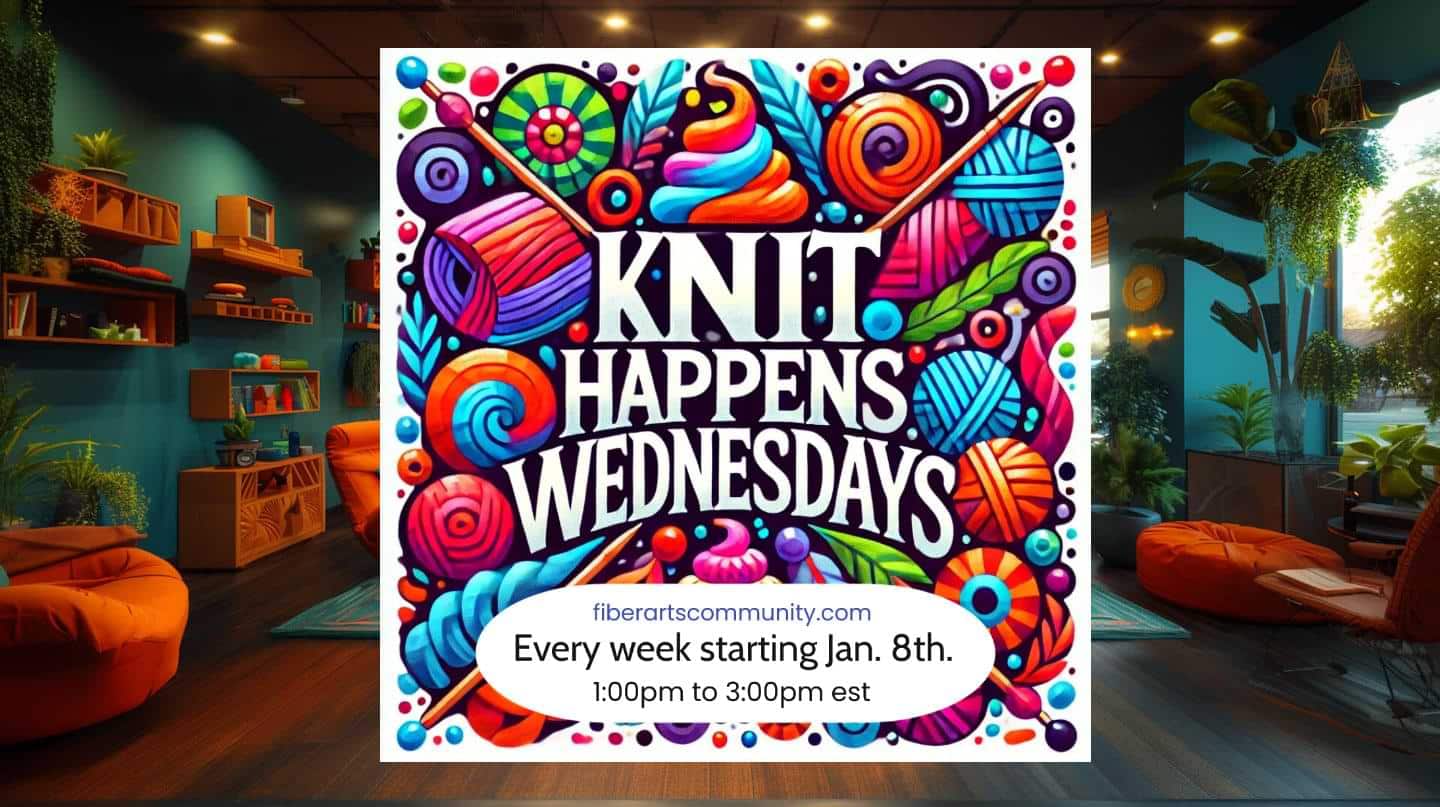
So I’ve set a date. Starting January 8th, 2025, the Fiberarts Community will host “Knit Happens Wednesdays” every week from 1 PM to 3 PM EST.

I have a friend who started her own initiative—something she truly believed in. She picked a time and just… showed up. Week after week, she sat there alone until, one day, people started joining her. Slowly but surely, her passion built something that added real value to people’s lives.

That’s what I want for Knit Happens Wednesdays. I’ll be there every week—showing up, waiting, ready to welcome you. And don’t think I’ll let you forget about it! I’ll be reminding you in emails, the newsletter, the podcast, and on social media because I believe in this space and its bright future.

Community takes time to grow, but I know it’s worth the wait. I hope you’ll come, pull up a chair, and be part of it.

Let’s make Knit Happens Wednesdays something special—together.

Until next time friends...

D.I.Y.

Untangling tech for the creative brain.

I help neurodivergent makers and anyone dealing with tech-stack or workflow chaos clear digital clutter and build practical systems that actually work. 1:1 consulting and community co-working to help you get unstuck and finish what matters.

Let’s sit down 1:1 and build a workflow that actually works.
Drop into my Office anytime. If I’m online, I’ll greet you. If not, leave a note and I’ll get back to you.