
Hi friends. It’s hard to know where to start lately.
I’m Canadian, and I’ve been watching my neighbours to the south go through things that are, honestly, horrifying. The kind of stuff that makes your stomach drop because you can feel how fast fear gets normalised. I can’t pretend I fully understand what it’s like to live inside that every day, but I do know this: when people’s rights and safety start getting messed with, silence helps the wrong side.
My dad was a WWII vet. He watched the early signs of what was coming, and he signed up anyway. Not because he loved war, but because he didn’t want his future kids living in a world run by cruelty, propaganda, and people addicted to power. So when I see history rhyming, I don’t want to look away.
And as a fiberartist, I keep coming back to this truth: our crafts have never been “just crafts.” They’ve always carried meaning. Sometimes comfort. Sometimes identity. Sometimes straight-up defiance.
Which brings me to one of my favourite stories of quiet resistance.
Imagine this: a knitted hat as a protest
During World War II, when Norway was occupied by Nazi Germany (starting April 1940), ordinary people needed ways to show unity without getting hauled in for it. Big gestures were dangerous. So they did what humans always do under pressure: they got smart and subtle.
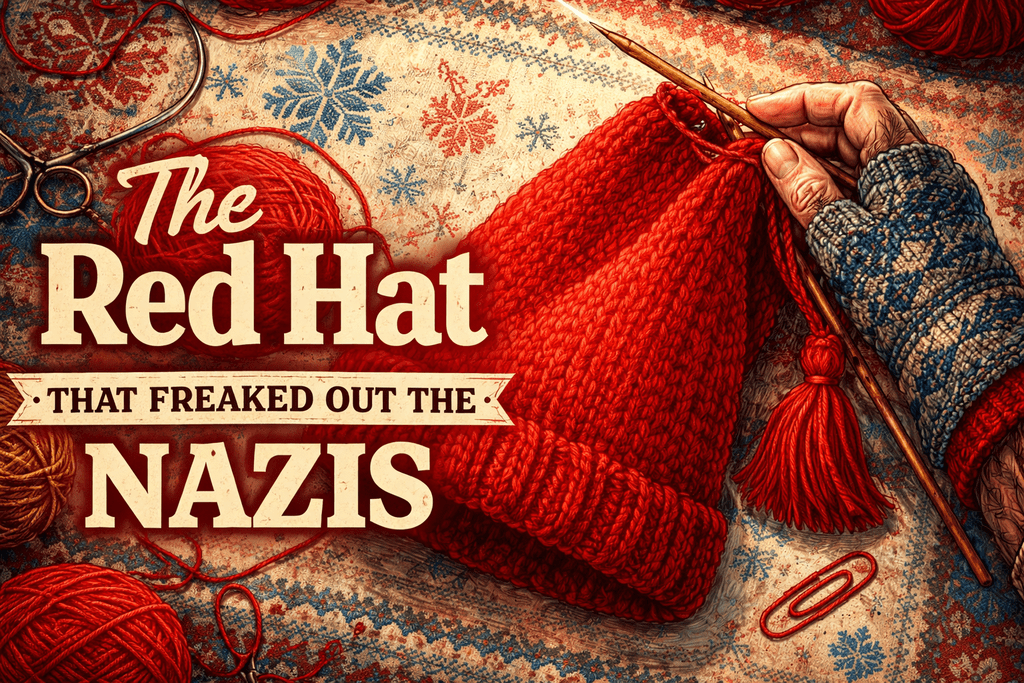
In Norway, one of those subtle symbols was a red, knitted, pointed winter cap with a tassel. It’s often called a nisselue (or rød topplue).
The guardian of the farm: the Nisse
This hat wasn’t invented as a protest symbol. It was already part of Norwegian culture.
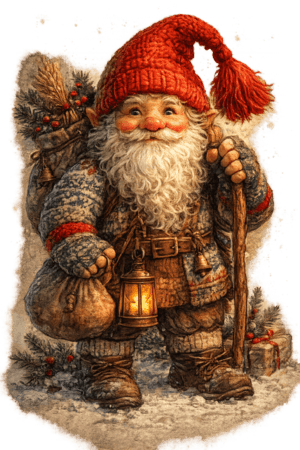
The red cap is tied to the Nisse, a gnome-like guardian figure in Norwegian folklore, connected to farms, home, and Christmas traditions. Nisser are basically always pictured in that bright red cap.
So when the occupation tried to crush Norwegian identity, the hat became more than a cute folklore thing. It became a flag you could wear on your head.
A silent, colourful rebellion
People started wearing the red nisselue as a way of saying: we’re still us.
It wasn’t loud. It wasn’t violent. But it was visible. Teens wore them in the streets. Artists put red-hatted nisser on Christmas cards alongside very Norwegian imagery and phrases like “God norsk jul” (“Good Norwegian Christmas”). Those cards were not subtle, and authorities treated them like open defiance.
There was also a broader crackdown on national symbols around that time. In late 1941, there were bans around using the Norwegian flag and its colours in ways authorities considered “demonstrations” against the occupation.
So yes. A red knitted hat could absolutely be seen as a political act.
The 1942 ban: “Stop wearing the red hats”
The red hats spread so widely that police in Trondheim basically said, “Okay, that’s enough.”
A notice dated February 23, 1942 warned that use of red toppluer had increased so much it was now considered a demonstration. The ban would apply starting Thursday, February 26, 1942. Hats could be confiscated, people could be punished, and for children under 14, the parents could be held responsible.
Let that sink in for a second.
Not a weapon. Not a poster. Not a protest march.
A red knitted hat.
That’s how fragile authoritarian control is. It panics over symbols, because symbols spread faster than orders.
And of course, the knitters pivoted
Norwegians didn’t stop resisting. They adjusted.
After the crackdown, you start seeing Christmas cards with nisser wearing hats in yellow, blue, or green instead of red, or cards that play games with the symbolism.
And alongside the hats, people used other quiet symbols too, like the paperclip worn on lapels, meaning “we are bound together.”
The pattern is always the same: when people are threatened, they find each other. When speech is controlled, they communicate sideways.
Knitting the resistance today
There’s something deeply grounding about touching this history with your own hands. Casting on stitches that someone else once knit under threat is not just “making a hat.” It’s choosing to remember. It’s choosing to pay attention.
If you want to add this to your project list, here a great Ravelry option:
Melt the ICE Hat by YarnCultMN: a modern pattern inspired by the same red-hat symbolism, published January 2026, written for DK and worsted weight, with 200–250 yards listed.
(All proceeds from the sale of this pattern go to the immigrant aid agencies who will distribute the funds to those impacted by the actions of ICE)
Closing: what do we do with any of this?
I don’t have a neat little bow to tie on this, because real life isn’t neat.
But I do believe this: as citizens of the world, we don’t get to outsource our morals. The best we can do is stay awake, stay curious, stay connected, and use whatever we have to push back against dehumanization, everywhere. Sometimes that looks like donating, calling reps, showing up for a neighbour, supporting journalists, or protecting someone who’s being targeted. Sometimes it looks like building community so people aren’t isolated. And sometimes, yes, it looks like making something with your hands that says: you are not alone.
Because history doesn’t just remember the loud heroes. It remembers the millions of ordinary people who refused to let fear become normal.
Until next time friends...