What an Old Sock Pattern Taught Me About Modern Business
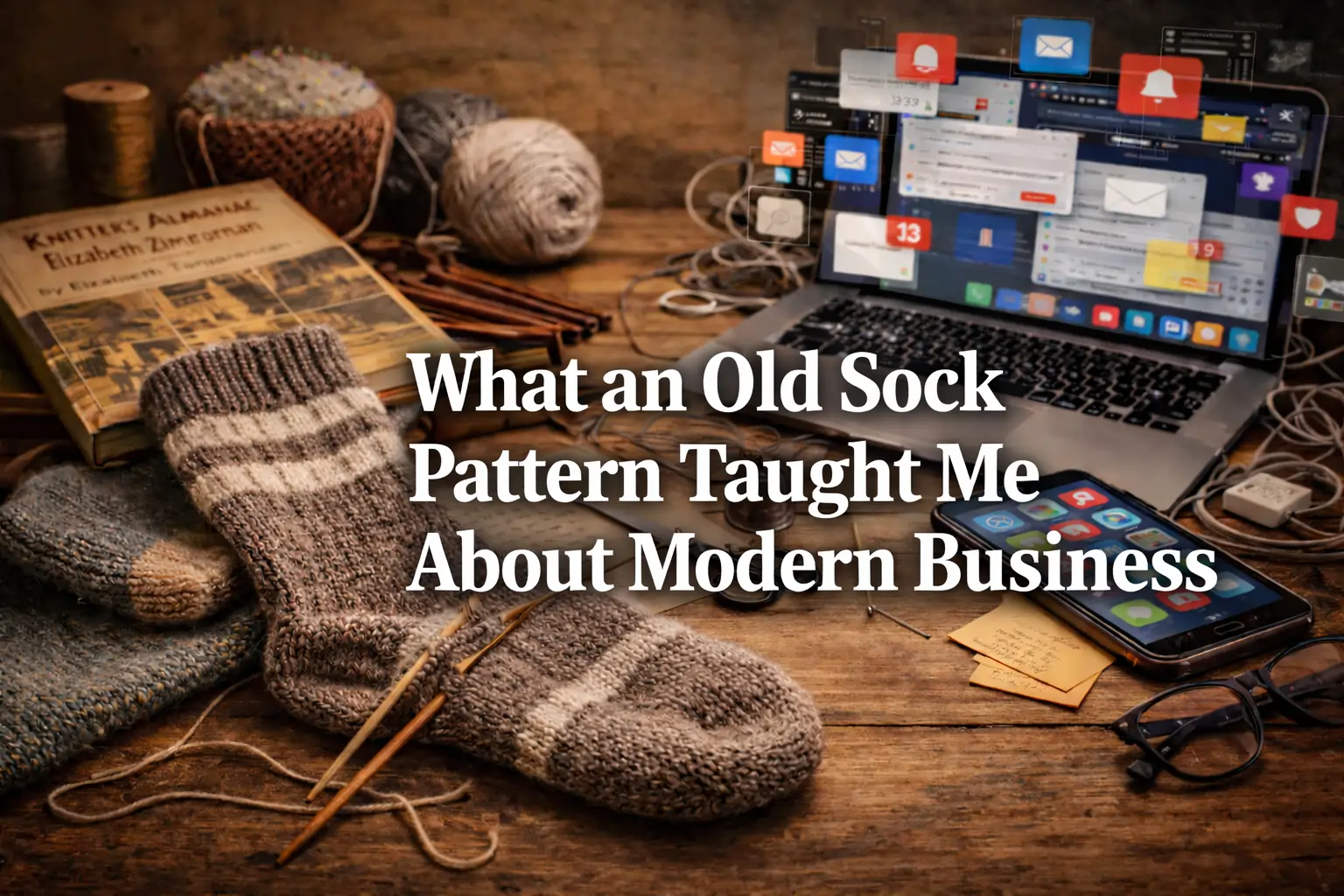
Creative entrepreneurs are out here collecting apps like craft supplies.
We tell ourselves each shiny new tool is going to save time, fix our workflow, organize our brains, and quietly handle the boring parts of running a business while we get back to the fun stuff.
And then somehow we end up three hours deep in settings, integrations, tutorials, and mild resentment.
At that point, the tool is not helping.
We are helping the tool.
Which is how I ended up thinking about Elizabeth Zimmermann, Knitter’s Almanac, and a very smart sock pattern that taught me more about business systems than half the productivity nonsense on the internet.
When I was a novice knitter, I overlooked Elizabeth Zimmermann.
Not just her, either. I overlooked a lot of older knitting patterns. Wartime patterns. Practical patterns. The sort of patterns written by people who clearly knew exactly what they were doing and did not feel the need to seduce me with glossy pages and styled photography.
Meanwhile, younger me was over there falling for the sparkly new patterns. The glossy ones. The polished ones. The ones that looked modern and exciting and somehow more approachable because they were prettier.
Which, in hindsight, was adorable.
And also not especially smart.
The truth is, newer and shinier are not automatically better. That applies to knitting patterns, and it absolutely applies to business tools.
Same pattern, different yarn.
Creative entrepreneurs do this exact same thing all the time.
We skip past the solid, practical, proven option because the new thing looks exciting. It sounds smarter. It has better branding. It promises to make the boring parts disappear so we can get back to being creative little goblins making cool stuff in peace.
We imagine a smoother workflow. A calmer brain. A cleaner system. A magical life where admin quietly takes care of itself and every platform behaves.
And then we spend six hours trying to configure the thing.
Same pattern. Different yarn.
Instead of using the tool, we end up serving it. Feeding it information. Adjusting ourselves to suit it. Rebuilding our workflow around it. Troubleshooting it. Looking up tutorials for it. Wondering why our supposed solution has now spawned three fresh problems and an identity crisis.
That is not simplification.
That is unpaid tech support.
Turning a heel used to feel like black magic.
It took me several years to actually turn a heel.
Years.
This was pre-internet. No videos. No knit groups. No cheerful person on YouTube calmly explaining heel construction while I paused every twelve seconds and muttered at the screen like a confused raccoon.
It was just me, some books, my knitting, and a growing suspicion that turning a heel was some kind of private joke the knitting world was playing at my expense.
I would start.
Try.
Get confused.
Put it down.
Come back later.
Try again.
Get confused in a fresh new way.
Glare at the sock like it had personally betrayed me.
It reminds me a lot of learning to tat. If you have ever struggled with flipping the knot, you know that exact moment when your hands are trying, your brain is buffering, and absolutely nothing makes sense until suddenly it does.
That was heel-turning for me.
The problem was never that I was incapable of learning it.
The problem was that I did not yet understand how it was built.
And honestly, that turns out to be the lesson over and over again.
In knitting.
In business.
In systems.
In life.
I wasted time not respecting the women who already knew.
This is the part that makes me wince a little.
I wasted a lot of time not fully respecting the experienced knitters who came before me.
Not because I thought they had nothing to offer. I was just distracted by prettier packaging. I assumed the newer patterns had to be smarter, easier, and more advanced. I figured the older stuff was probably dry, plain, and less relevant.
Which was cute.
And wrong.
What I eventually learned was that those older patterns were carrying serious knowledge. Construction. Fit. Function. Wear. Repair. Practicality. The kind of understanding that comes from people making things for actual life, not just for pretty pictures.
And honestly, this is exactly what happens in business too.
Creative entrepreneurs ignore simple methods because they do not look sexy enough. We dismiss foundational systems because they lack sparkle. We chase the new thing because it feels like progress.
Then we end up with a workflow held together by subscriptions, browser tabs, blind optimism, and one emotional support beverage.
Enter: The Sock Queen
I was recently talking with a friend I am going to call The Sock Queen, because socks are her favorite thing to knit and frankly she has earned the title.
We were talking about my frustration with mending socks.
This is a real issue in my house because my husband loves my handknit socks. Not only do they fit his size 15 feet far better than commercial socks, but he says he can “feel the love.”
Which is very sweet.
And also wildly inconvenient when I am trying to be annoyed about sock repair.
Because what exactly am I supposed to say to that?
“Sorry, babe. The love is currently in the shop.”
That conversation brought me back to Elizabeth Zimmermann’s refootable sock, and that is where the lightbulb really went on for me.
The refootable sock is really a whole philosophy
The brilliance of the refootable sock is not just that it is clever.
It is that it is sane.
When the wearing part goes, you do not treat the whole sock like a lost cause. You keep what still works and rebuild the part that does not.
That is such a practical, grounded, no-nonsense approach.
And it is also exactly the opposite of what so many of us do in business.
We are constantly encouraged to replace instead of repair. Switch instead of simplify. Rebuild instead of understand. Start over with the shiny new platform instead of asking whether the old system actually worked just fine with a few thoughtful adjustments.
Zimmermann’s sock offers a much saner idea:
Understand the structure.
Keep what works.
Repair what doesn’t.
Do not make things more complicated than they need to be.
That is knitting wisdom.
That is business wisdom.
That is life wisdom, honestly.
Simple is not boring
This is the lesson I wish more entrepreneurs could hear before they lose an entire weekend trying to force some overcomplicated tool into a workflow it was never meant to support.
Simple is not lazy.
Simple is not unsophisticated.
Simple is not behind.
Sometimes simple is the most intelligent choice available.
A plain practical knitting method that works is better than a flashy pattern that leaves you confused.
A repairable sock is better than a precious one that cannot survive actual life.
A simple business system that supports the way you naturally think and work is better than a shiny digital octopus that needs constant setup, feeding, tweaking, troubleshooting, and emotional support.
If your tools are creating more work than they remove, that is not efficiency.
That is admin drag in a cute outfit.
The older I get, the more I value old wisdom
What I missed when I overlooked Zimmermann and those older patterns was not just a technique.
It was a mindset.
A respect for structure.
A respect for function.
A respect for things built to last.
And maybe most of all, a respect for knowledge that does not need to shout to be valuable.
That mindset has changed the way I think about knitting now, but also the way I think about business, systems, and creative work in general.
You do not need the newest tool just because it exists.
You do not need the shiniest workflow just because somebody wrote a slick sales page about it.
You do not need to rearrange your whole brain to satisfy a platform.
You need tools that support your work.
You need systems that fit the way you actually think.
You need solutions that make your life easier, not ones that quietly turn you into unpaid support staff for your own software.
So yes, a sock humbled me
It turns out Elizabeth Zimmermann was not just teaching knitters how to make a sock.
She was teaching us to think.
To understand construction.
To value function.
To repair instead of replace.
To stop being dazzled by shiny nonsense long enough to notice what actually works.
That lesson lands just as hard in business as it does in knitting.
So if you are a creative entrepreneur side-eyeing your growing collection of apps, subscriptions, platforms, and complicated little “solutions,” maybe this is your sign.
The answer is not always newer.
The answer is not always shinier.
And the answer is definitely not a tool that makes you work harder just to justify its existence.
Sometimes the best solution is the one that is simple, sturdy, repairable, and wise.
Annoying, I know.
But there it is.
Untill next time friends...