Ender-3 V3 KE Review for Beginners – 3D Printing on Linux Mint as a Fiber Artist

by artemisnorth | Nov 15, 2025 | Tech for Makers & Creative Entrepreneurs | 0 comments

There comes a point in far too many small business websites where the whole thing stops feeling like a useful tool and starts feeling like the kitchen junk drawer.

You know the one.

You open it looking for one thing and suddenly you’re elbow-deep in dead batteries, mystery keys, elastic bands, expired coupons, two pens that do not work, and a screwdriver that apparently lives there now for reasons no one can explain.

That is a lot of small business websites.

And if your website feels weirdly hard to update, manage, or trust, the problem may not be you. It may be that the site has become cluttered, outdated, or structurally messy over time.

You go in to fix one tiny thing. Change a sentence. Swap a button. Update a date. Add a link. Nothing dramatic.

Cute.

Forty minutes later, you’re wandering through old pages, duplicate drafts, weird settings, mystery plugins, and images named things like final-final-2-reallyfinal.jpg, wondering which version of past-you made these choices and why she was allowed near the controls.

That is not a discipline problem.

That is a structure problem.

When your website starts fighting back

A lot of people assume website stress means they are disorganized, bad at tech, behind on everything, or somehow failing at adulthood.

Usually, that is not what is going on.

Usually what happened is much less dramatic and much more annoying.

The website grew.
The business changed.
Offers shifted.
A new page got added.
A tool got bolted on.
Something broke.
Something got patched.
Something got ignored because you were busy and it seemed fine enough at the time.

Which, to be fair, is how a lot of business decisions get made when you are one person trying to do seventeen jobs and occasionally eat lunch.

So no, this does not mean you ruined your website.

It usually means the site has been collecting layers.

And layers create friction.

Not all at once. Just steadily. Quietly. Like digital plaque.

What a messy small business website actually looks like

The sneaky part is that it does not always look terrible from the outside.

Sometimes the homepage still looks perfectly decent. Sometimes the branding is nice. Sometimes the site even works well enough that nobody is actively screaming.

The trouble usually shows up behind the scenes.

It looks like this:

  • too many old pages hanging around because you are afraid to delete the wrong one
  • blog categories that made sense once and now mostly raise questions
  • plugins you no longer use but do not quite trust yourself to remove
  • settings buried in seventeen different places for no good reason
  • duplicate images and mystery files breeding quietly in the media library
  • pages you avoid editing because every time you touch them, something gets weird
  • a backend that turns every “quick update” into a whole production

And here is the part that matters:

When your website is hard for you to manage, it often becomes harder for visitors to use too.

Not always in a big flashing-error way.

Sometimes it shows up as clutter, confusion, inconsistency, dead ends, outdated information, missing context, or just that faint but unmistakable feeling of, “Hm. Something here is a little janky.”

People may not know exactly what is off.

They just feel the drag.

The hidden cost of website clutter

A website junk drawer does not just waste time. It eats momentum.

Every small update starts to feel mildly cursed. You put things off, avoid publishing, and start dreading tasks that should be simple.

That is the real cost.

Not just the mess itself, but the mental drag of a tool that quietly trains you to avoid using it.

That is how a business website turns into background stress.

It is the same kind of low-grade friction that shows up in other parts of running a business too. Small things are not always small when they keep draining time, attention, and energy. You can explore more of that in the Business & Workflow section of the site.

Why simple website cleanups turn into bigger jobs

Sometimes you think you are doing a quick little website tidy.

Delete a few things. Clean up a page or two. Be responsible. Feel accomplished.

Adorable.

Because once you start pulling at the threads, you often realize the clutter was not the whole problem.

The clutter was just sitting on top of bigger structural issues.

Old content overlaps with current offers.
Page hierarchy stopped making sense somewhere around three pivots ago.
Images are missing proper names or alt text.
SEO details were never actually finished.
Accessibility got patchy.
Navigation evolved by accident instead of on purpose.

So what looked like a bit of housekeeping turns into a real audit.

Annoying? Yes.

Useful? Also yes.

Because now you are finally seeing what the website has been trying to tell you with all its weird little acts of resistance.

I wrote about that kind of domino effect more directly in How a Website Cleanup Turned Into an SEO and Accessibility Audit.

Signs your website needs a cleanup

Here are a few.

Small edits take way too long

You should not need a snack, a pep talk, and a support ferret to update one section of a page.

You are never fully sure what is live

If you have to squint at your own website like a suspicious Victorian aunt, something is off.

You keep finding outdated pages or half-finished bits

That usually means the site has grown without a clean structure underneath it.

You avoid touching parts of the site

Not because you are lazy. Because you do not trust what will happen if you breathe on them.

The backend feels heavier than it should

Too many decisions. Too many steps. Too many places for things to hide and wait for you like little goblins.

If several of these sound familiar, you do not have a motivation problem.

You have a website friction problem.

What to do first

You do not need to fix the whole thing in one dramatic burst of digital righteousness.

Please do not do that to yourself.

Start smaller.

1. Figure out what actually matters now

What pages, offers, and content are still relevant to the business you have today?

Not three rebrands ago. Not two pivots ago. Not that lovely idea you had in a fit of optimism and never fully used.

Now.

2. Identify the obvious clutter

Old pages. Duplicate drafts. Unused images. Abandoned ideas. Expired announcements. Offers you do not even want anymore.

You do not have to delete everything immediately. This is not a purge montage.

But you do need to know what is taking up space.

3. Map the core structure

What are your main pages?
What do visitors most need to find?
What do you most need to update regularly?

That gives you a practical picture of what the site is actually supposed to support.

4. Notice where you feel resistance

Which tasks always feel more annoying than they should?

That is usually where the mess is costing you the most.

Pay attention to the spots that make you sigh before you even click. Your nervous system knows things.

5. Stop treating every website problem like a personal flaw

A messy website is usually what happens when a real business grows in real time and nobody gets around to rebuilding the plumbing because they are busy trying to run the actual business.

That is not a character defect.

That is maintenance catching up with you in ugly shoes.

Your website is supposed to support the business

Not haunt it.

Not confuse you.

Not punish you for trying to update a sentence.

A website does not need to be perfect. It does not need to be massive. It does not need a thousand bells, whistles, and dashboard goblins demanding snacks.

It does need to be usable.

Clear enough that visitors can find what they need.
Clean enough that you can manage it without losing the will to live.
Structured enough that it supports the business instead of creating more drag around it.

That is the real goal.

Not perfection.

Usability.

Because a business website should feel like a tool.

Not an escape room.

Final thought

If your website feels harder to manage than it should, the answer is probably not to shame yourself into “being better at it.”

The answer is to look at the structure, the clutter, the outdated bits, and the friction points, and start untangling what is actually going on.

Because your website should not feel like a drawer full of mystery wires, expired coupons, and decisions made by a sleep-deprived raccoon.

It should feel like something you can use without needing emotional backup.

And honestly, that is not asking too much.

If your website feels harder to update, manage, or trust than it should, that is exactly the kind of mess I help untangle in TechAlchemy. Get in touch here and we’ll look at what is clutter, what is broken, and what to fix first.

We finally did it. We jumped on the 3D printing wagon, and honestly, it is way better than I expected.

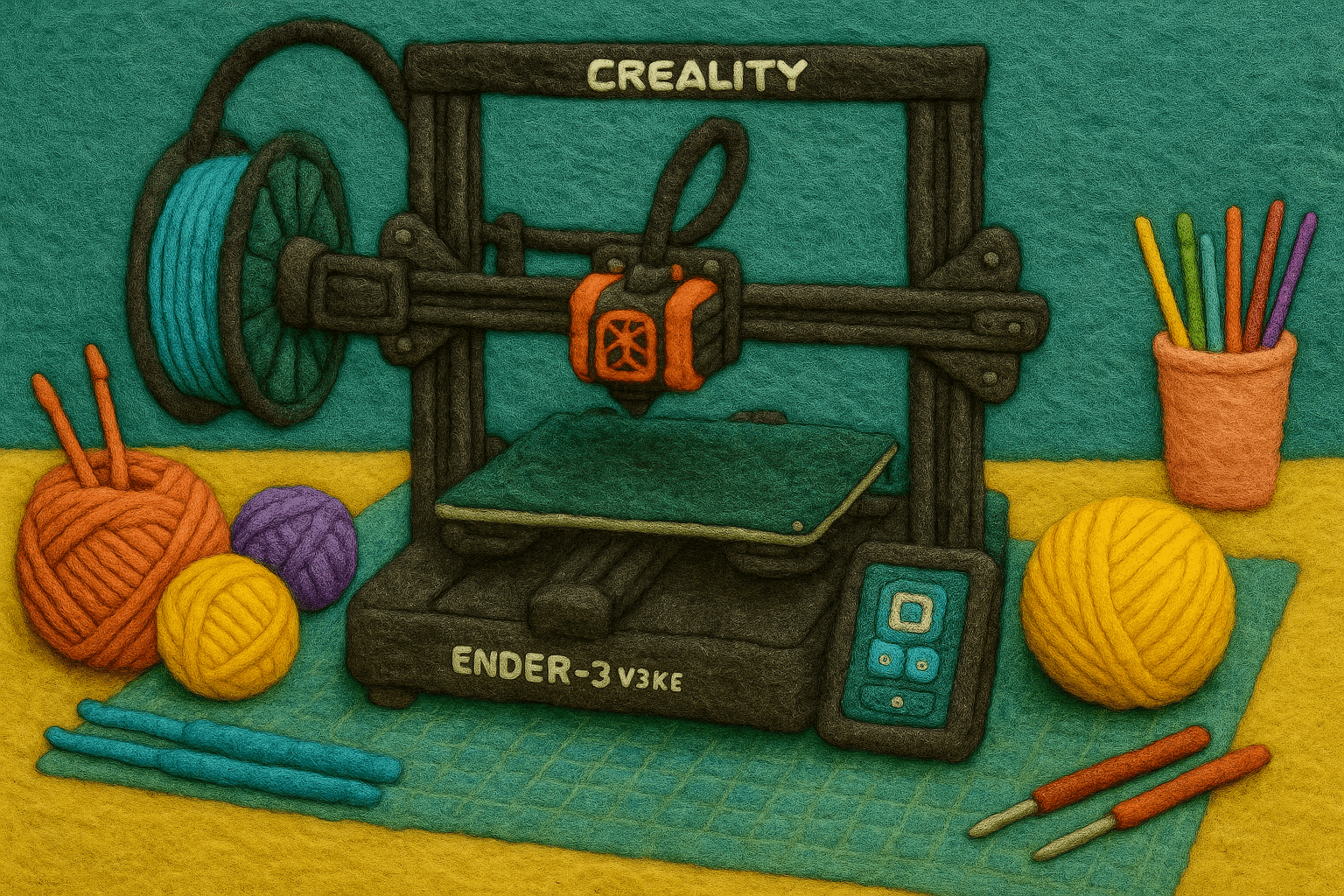
My hubs and I spent far too many nights down the "best beginner 3D printer" rabbit hole before we landed on the Creality Ender-3 V3 KE 3D printer. It is marketed as friendly for beginners and hobbyists, and after a week with it, I would say they are not wrong.

Is this a super technical Ender-3 V3 KE review? Nope. This is the "real human learning 3D printing for beginners while chasing dopamine" version.

Why I Wanted a 3D Printer as a Fiber Artist

I have been a fiber artist for decades, happily collecting techniques like other people collect mugs. Knitting, crochet, mixed media, photography, art... if it lets my hands stay busy, I am in.

The problem: I take my projects everywhere.

That means I have spent a ridiculous amount of time (and more money than I want to admit) trying to figure out the best way to:

  • Carry my yarn and projects
  • Keep tools from stabbing through bags
  • Not lose tiny scissors, needles, and stitch markers in the bottom of the void

So when I started looking into 3D printing for crafters and fiber artists, my brain went:

"Oh. This is it. This is NerdVanna."

I wanted a printer that would let me create:

  • Tool organizers
  • Yarn and project containers
  • Photography gadgets
  • Fun gifts for friends and family

Enter the Ender-3 V3 KE.

3D Printing on Linux Mint: Installing Creality Print

I am running **Linux Mint**, so one of my first questions was:
*Can I actually get the slicer software to work without a three day meltdown?*

Good news: yes.

I downloaded Creality Print and got it running on Linux Mint without drama.

Quick note for Linux Mint users:
Install the Flatpak version using `sudo` so everything has the permissions it needs.

Once it was installed and I opened Creality Print for the first time, I felt like I had just landed in a strange new world.
Buttons everywhere. Grid. Ghost printer. Settings. More settings.

And you know what? It was fantastic.

creatity print scrnsht

This is where the "3D printing for beginners" journey really starts: awkward clicking, random hovering, and the eternal question:

"If I press this, will it explode or just slice something?"

Discovering Free 3D Print Files: Thingiverse Adventure

One of the best parts about getting into 3D printing as a beginner is realizing there are already entire libraries of free projects out there.

My first stop: Thingiverse.

For a total newbie, it felt like a toy store. I started with photography tools and found:

Very cool. Very useful. But this is not what broke my brain.

That happened when I typed one little word into the search bar:

"yarn"

3D Printing for Fiber Artists: The Yarn Ball Container

Front and center was this glorious thing:

firstcaseprint2

Surprise Yarn Ball Container

A container that looks like a ball of yarn.
Roughly the size of a 100 g skein.
Designed to hold tools.

For someone who lives inside a yarn-filled brain, this was a direct hit.

I needed this print in my hands yesterday.

Slicing, Printing and Failing Forward

So I downloaded the files, pulled them into Creality Print, stared at the screen and thought:

"Hmmm... now what?"

My husband had already printed the iconic little Benchy boat, which in 3D printing world is the starter boss, so he was officially "slightly more experienced."

Together we:

1. Chose the Ender-3 V3 KE as the printer profile
2. Let Creality Print do auto-supports
3. Sliced the model
4. Exported it to the printer
5. Hit print and hoped for the best

We printed the first half of the container. Twice.

And it was… not great.

  • Holes where there should never be holes
  • Walls too thin and flimsy
  • Not even close to "tossable in a project bag" quality

I was disappointed, but if there is one thing fiber arts has trained me for, it is stubborn persistence. If I can frog an entire sweater and start over, I can reprint a fake ball of yarn.

Finding a Better Remix: Screwed Together, Not Popping Open

While the second print was going, I did what any proper crafter does when something is not working: I opened another tab and kept going.

Digging deeper into Thingiverse, I found a remixed version of the yarn ball container where the two halves screw together.

Even better:

  • No random popping open
  • No tools rolling across the floor
  • Less chaos in my bag

I downloaded the remix, pulled it into Creality Print, and did a bit more research into:

  • Wall thickness
  • Infill percentage
  • Print speed

Then I held my breath, clicked **Print**, and walked away before I could start micromanaging the machine.

Victory: A Yarn Ball Tool Container That Actually Works

This time, it worked.

The new version printed beautifully:

  • The walls were thicker and solid
  • The container was basically watertight
  • The supports snapped off without too much fuss
firstcaseprint

End result:
I now have a yarn-ball-shaped container that:

  • Holds my hooks, needles, and tiny scissors
  • Screws securely closed
  • Fits perfectly in the pocket of my bag

My precious tools are now living inside a fake ball of wool, and I am unreasonably happy about it.

This is exactly the kind of thing that makes **3D printing for fiber artists** so powerful. It is not just toys and figurines. It is:

  • Custom organizers
  • Project-specific containers
  • Little quality-of-life upgrades for your making life

3D Printing for Beginners: What I Have Learned So Far

After just a week with the Ender-3 V3 KE and Creality Print on Linux Mint, here is my quick beginner take:

What I am loving

  • Beginner friendly setup: Once we got a feel for it, the Ender-3 V3 KE has been approachable, even as a first 3D printer.
  • Linux Mint friendly: Creality Print runs on my Linux system, which makes my inner nerd very happy.
  • Endless project ideas: Thingiverse and other repositories make it easy to start printing right away without designing everything from scratch.

What I am still figuring out

  • Dialing in the "perfect" print settings
  • Understanding when to tweak wall thickness, supports and infill
  • Not starting five new prints in a row just because I found a cute gadget

Christmas, Gifts and Future Chaos

Christmas is creeping closer, so I am not going to spoil what we are printing for friends and family. Let us just say:

  • The Ender-3 V3 KE is getting a workout
  • We are absolutely using 3D printing for gifts
  • My creative and nerdy sides are having a full-on party

3D printing has officially joined the list of tools in my creative studio, right next to the yarn, hooks, needles and paints.

If you are a crafter or fiber artist wondering whether 3D printing for beginners is worth the trouble, here is my answer after one week:

Yes. Especially if you are the kind of person who gets way too excited about storage solutions, custom tools and yarn-shaped containers.

Stay tuned. This is only the first layer.

Until next time friends...

reindeer costume

Untangling tech for the creative brain.

I help neurodivergent makers and anyone dealing with tech-stack or workflow chaos clear digital clutter and build practical systems that actually work. 1:1 consulting and community co-working to help you get unstuck and finish what matters.

Let’s sit down 1:1 and build a workflow that actually works.
Drop into my Office anytime. If I’m online, I’ll greet you. If not, leave a note and I’ll get back to you.